
Holding Company CRM
When every subsidiary builds its own system, the group-wide sales table is merged by hand every month, and holding management cannot see the real state of the pipeline until the quarter has closed.
Each subsidiary is a separate unit; a record carries in a field which company it belongs to. When the same customer is opened at two subsidiaries the records match and the histories sit side by side.
What we set up, and how
- Define each subsidiary as a separate unit and run it with its own sales process and pipeline stages
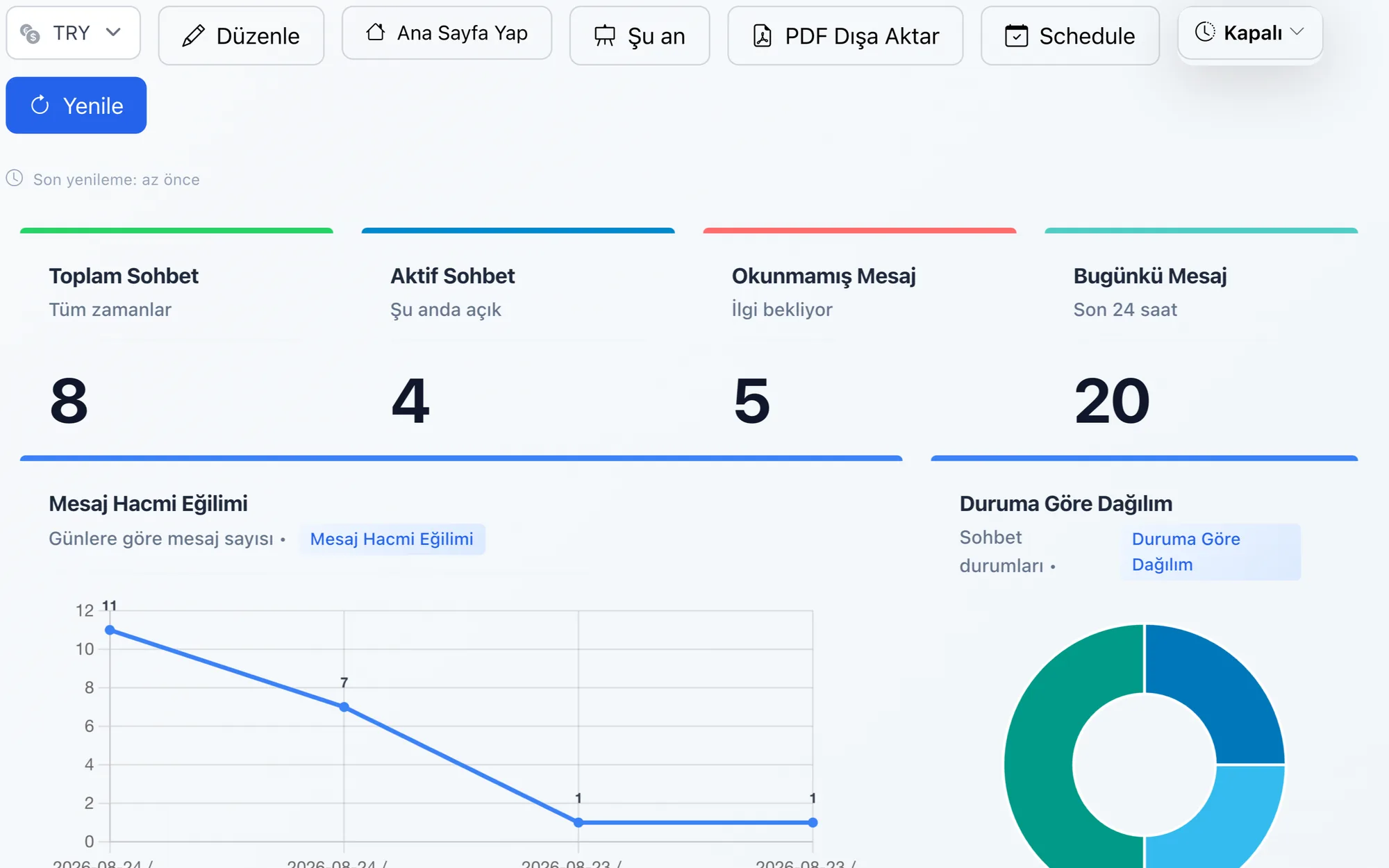
- Consolidate the sales, pipeline and customer data of the group companies on a single dashboard
- Let users see only their own company's data while opening all of the data to holding management
- Route a customer won at one subsidiary to the other group companies as an opportunity
- Have the whole team answer from a single WhatsApp business number and assign conversations in the team inbox
| Multi-Company Management | Each subsidiary is defined as a separate unit; records carry in a field which company they belong to, and sharing between companies is set up over that field. |
|---|---|
| Consolidated Holding Reporting | Because the data sits in one place, the group report is taken by grouping on the company field; there is no need to collect files from the subsidiaries. |
| Subsidiary-Based Access Permissions | Visibility is set up with role-based permissions; a user sees the records of their own company, while the holding role sees all of them. |
| Cross-Selling Opportunities | An account won at one subsidiary can be opened as a new opportunity at another company; because the source record stays linked, which company it came from is tracked. |
| Intra-Group Request Handover | A request one subsidiary cannot meet is handed over to another company's queue with its source preserved; the handover date, the transferring unit and the person taking it on sit in fields defined during setup, and the response after the handover is followed from the same record. |
In a holding the same firm works with more than one subsidiary, but nobody knows it: while one company is renewing a contract with the purchasing manager, another asks the same firm for an introductory meeting from scratch. This blindness wastes both the group's bargaining power and an opportunity already standing inside the door.
Rapitek CRM keeps subsidiaries separate with their own data while matching the customer record at group level; one company's contact history sits on another's screen as context. Because correspondence runs over a single business number, when staff change the history stays on the record rather than on a personal phone.
