
CRM for auto parts dealers, wholesalers and retailers
Vehicle details, stock enquiries, quotes and dealer price lists in one system. Run your wholesale, retail and B2B dealer channels as separate processes. It is configured around your own processes, and we do the setup.
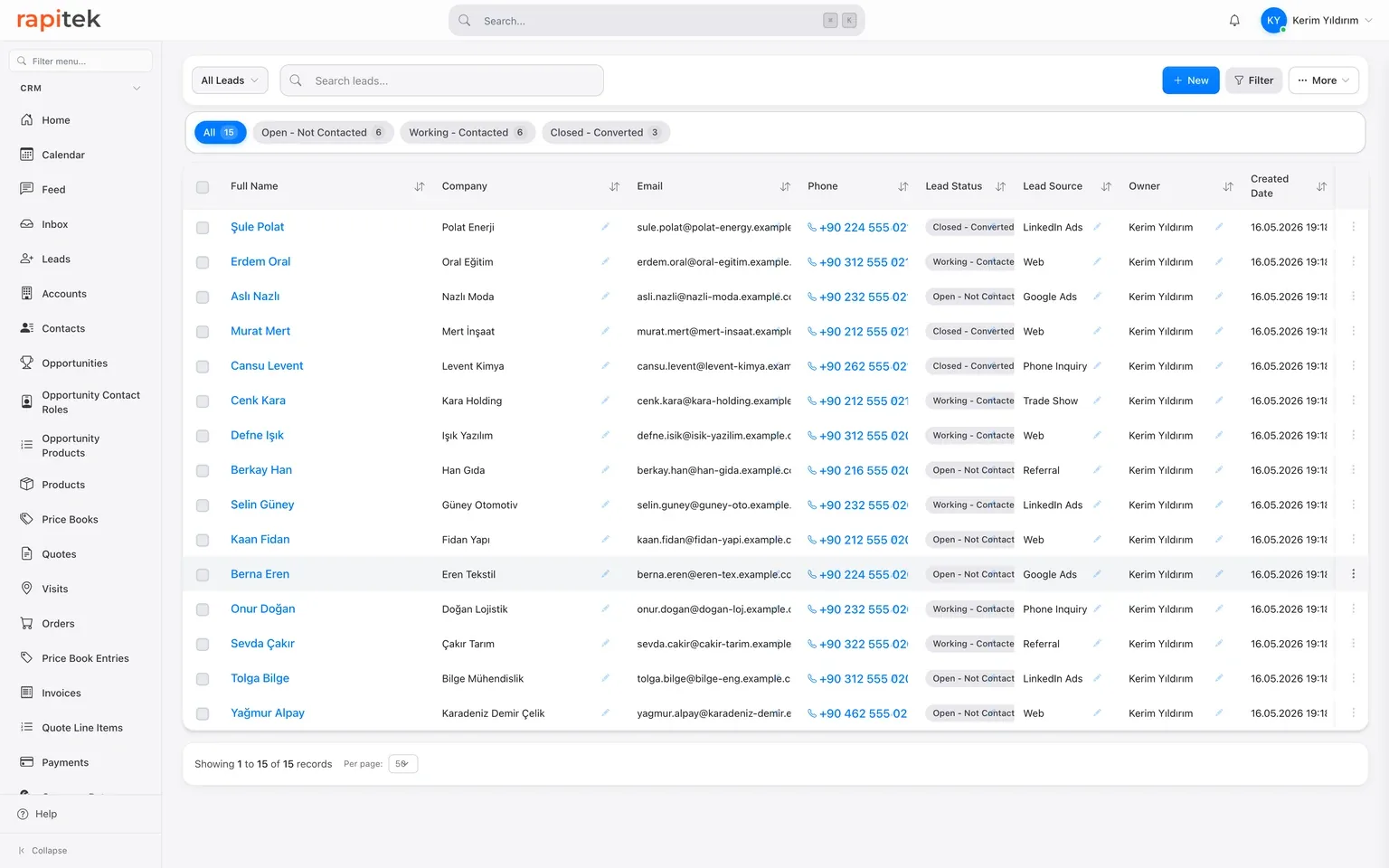
In auto parts, when an enquiry is never recorded, its outcome cannot be measured
Stock and invoicing are already handled by a separate program in your business. The place that bleeds is the space between the enquiry and the sale: who asked for what, which vehicle they were looking at, whether a quote went out, and why it was not taken.
Here is the picture we have seen again and again in our own CRM projects:
- The day goes by on the phone; “do you have this part for that vehicle?” enquiries stay on the phone and in the salesperson's personal WhatsApp. When an enquiry is never recorded, its outcome cannot be measured: whether it was bought, or bought somewhere else, nobody knows.
- When the same garage calls for the third time, the vehicle details are asked all over again; which customer works on which vehicles lives in the salesperson's memory.
- The quote is in Excel or in a chat bubble; nobody keeps track of which quote never got a reply.
- Dealer discounts are in the salesperson's head; because the discount table is not recorded anywhere, there is no check that catches it when a price is given from the wrong list.
- The account balance sits in the accounting program; when the salesperson quotes, they do not see the customer's payment terms or credit risk.
None of this is solved by a new stock program. It takes record-keeping discipline and properly configured fields, which is exactly what a CRM is for.
Tuesday 09:40. A garage calls: “Front pads and discs for a 2016 diesel Focus, needed today.”
-
1
The enquiry becomes a record while the call is still on
The calling garage is matched to its account record; the enquiry is opened as an opportunity tagged with its source (phone, WhatsApp). It is written into the sales pipeline, not into a notebook.
-
2
Vehicle details are stored as fields
Make, model, year and engine type are held as separate fields, not as free-text notes. When the same garage calls again, the vehicle is not asked for a second time; past enquiries stay on the record.
-
3
The part is found from the OEM or the cross-reference code
Because the product record holds the OEM number, cross-reference codes and vehicle fitment details as fields, search and filters work on those fields. If your ERP is the master source for stock quantities, it can feed the CRM through the flow defined during setup.
-
4
The quote goes out as a PDF from the price list
The price comes from the price list the customer is attached to; the discount is visible on the record. The PDF quote is sent over WhatsApp from the office's single business number, and the conversation is logged on the customer record.
-
5
An unanswered quote waits in the pipeline instead of being forgotten
Every quoted enquiry stays in the pipeline as an open opportunity; a follow-up task and a reminder are set. The answer to “who did we quote yesterday, and who never came back?” is on screen as a list.
-
6
The outcome is closed with a reason
If the sale happens, the quote turns into an order; if not, a closing reason such as “it was out of stock” or “the price was too high” is selected. At month end, a report shows how many enquiries were lost in which part group, and why.
The building blocks we set up for auto parts teams
Customer and account records
Garages, dealers, fleets and retail customers are held as separate records. Account details such as payment terms, due dates and credit limits are modelled as fields on the record; the salesperson sees them while quoting. The official source of the account statement stays in your accounting program.
Vehicle and part fitment data
The product record holds the OEM number, aftermarket (cross-reference) codes and vehicle fitment details as fields; search and filters work on those fields. There is no magic here: properly configured fields and correct data imported from your own catalogue.
Quotes and orders
Price list, discount, PDF generation and conversion into an order in a single flow. Multiple currencies are supported; exchange rates are pulled automatically from the Central Bank of Türkiye (TCMB) every day. No manual rate arithmetic when you price imported parts.
B2B price lists
Separate price lists are set up by dealer group, customer segment or channel. Which customer is priced from which list is configured: the discount table that lived in the salesperson's head moves into the system.
WhatsApp from a single number
All salespeople write from the company's single business number; messages land in a team inbox and are logged on the customer record. The connection we recommend and set up is Meta's official WhatsApp Cloud API. We do not present QR-code pairing as a product promise: it is not Meta's official API and risks the number being restricted by Meta; if that happens, your business number is shut down.
Demand and lost-sale reports
Which part group is in demand, which enquiries were lost and why, how many quotes and how many closes per salesperson, with tabular and summary reports and a drag-and-drop dashboard designer, without writing code. Matrix and joined report types are supported as well.
At the counter, in the warehouse, and with the software you already run
Mobile at the counter and in the field
Both our iOS and Android apps are live and ship with a Turkish interface; while checking a part in the warehouse, the salesperson can update the customer record, the quote and the follow-up task from their phone. Rapi, the voice assistant in the mobile app, creates and updates records in the CRM through spoken Turkish. WhatsApp messages are handled in a single inbox inside the app. An incoming enquiry can be answered while the salesperson is at the counter or on the road. Instagram direct messages land in the same inbox. Details are on the mobile app page.
Connecting to your accounting and ERP software
Rapitek CRM does not replace your stock and accounting program; it adds a customer relationship layer on top of it. The connection to your accounting or ERP program is built as follows: over the REST API, webhooks and import/export, by the team that builds and develops the product. Which data flows in which direction, and how often, we define together during the setup stage. The details of the approach are on the integrations page.
There is no out-of-the-box module. It would not be right to say there is. Because access differs from one installation to the next, there is no single button that works the same way in every installation; the connection is a scoped integration job and is planned as part of the setup.
If you also sell tyres, or if you have a sales team out on the road, similar flows apply to those channels as well.
Stock program or CRM? Both.
| Layer | What it does |
|---|---|
| Accounting / ERP / stock program | Stock quantities, purchase and sales invoices, account statements and official records |
| Rapitek CRM | Customer and vehicle details, the pipeline from enquiry to quote, dealer price lists, WhatsApp conversation history, lost-sale reports |
| The connection between them | REST API, webhooks and import/export; the scope is defined during setup with the team that builds and develops the product |
Measured data, not a marketing line
How is a CRM rolled out in an auto parts business?
-
1
Discovery and analysis
We map out your part groups, your sales channels (wholesale, retail, B2B dealer), your price list structure and your account flow. This is where we decide which fields you actually need.
-
2
Configuration
Customer and vehicle fields, the product catalogue, pipeline stages, price lists, the permission matrix and reports are set up around your process. No code is required; setting it up well takes expertise, and that part we do ourselves.
-
3
Data migration
Customer, vehicle and product records from your Excel files or from your current system are imported, and duplicate records are cleaned out.
-
4
Training and go-live
Training for salespeople and managers, close follow-up in the first week, and continuous support after that. We do not commit to a timeline before discovery; after the discovery call we give you a date, not a range.
What do the teams we work with say?
The most important element in bringing new business ideas to life is your IT infrastructure and your applications. Rapitek offered far more than simply supplying an application - they became our solution partner. Thanks to their fast responses in unexpected situations and their flexibility during development, we reached our first product quickly and kept the project running soundly.
 CEO · Aktif Filo

With Rapitek's solution-focused approach, we began the work needed to complete the improvements to the Salesforce customisations and integrations we were using quickly. With those improvements, duplication of data was prevented and we increased the efficiency of the system.
 Sales Director · Petroyağ

As a newly founded company that wanted to make fast progress, we realised we needed a general infrastructure for sales management, team tracking and inventory management. With that need, we started the project with Rapitek, and we are still working together today. Rapitek really is a solution partner.
 Operations Manager · Hürriyet Projeland

The references above relate to CRM implementation and integration projects carried out by Rapitek; they do not mean that those organisations use the Rapitek CRM product today. Brand names, logos and titles belong to their respective owners.
Data location, KVKK and security, as it is
In the auto parts business, customer data is a trade secret: your customer list, your discount rates, your account terms.
- Your data is held in the European Union. The database is in Helsinki (Finland), media files in Frankfurt, and backups in Falkenstein (Germany). We do not say that the data is held in Türkiye, because it is not.
- Under Article 9 of the KVKK, this counts as a transfer abroad. That is why a privacy notice is presented on our forms; the basis for the transfers in your own processes is something we establish together during the contract stage.
- TLS is used in transit. Passwords are hashed one-way; two-step verification secrets and the credentials for email, WhatsApp Business API, Instagram/Meta, payment and İYS connections are encrypted at the application level. A separate database is used for each customer.
- Role-based permissions are in place; which salesperson sees which customer group and which price list is defined.
We do not hold an information security certificate, and we do not claim to. Every technical detail we state has its counterpart in the system; we answer your security questions in writing before setup.
We put the number on the pricing page, not on this one
The scope of setup, data migration and training is not the same in every project; it is shared in writing after discovery. Plan prices we keep in one single place, so that you never read two different numbers in two places.
Three plans, the scope table and the separately priced items, all on one page.
Frequently asked questions about CRM in the auto parts industry
What is an auto parts CRM?
How is vehicle-to-part fitment tracked?
Can OEM and aftermarket (cross-reference) codes be tracked?
Does it do stock tracking?
Does it connect to our accounting or ERP program?
Can account balances and payment terms be tracked in the CRM?
Can we define prices and discounts specific to our dealers?
Can we run wholesale and retail sales as separate processes?
Can several salespeople use the same WhatsApp number?
Is there a mobile app for use in the field and at the counter?
Can we see the product before we buy it?
How long does setup take and what is included?
Where is our data held?
Try it on your own parts sales flow.
In a 30-minute intro call, let us show you enquiry capture, the vehicle and part fields, quote generation and dealer price lists on your own scenario. Then we open your 7-day trial account; no credit card required.
