
Digital Agency CRM
In an agency, profit is not lost during the project but after it: extra requests that are never tied to an approval quietly grow the job, and the finished job drops into the archive without producing a penny of maintenance revenue.
Every out-of-scope extra request is a separate record tied to the project record; its added time and cost sit in their own fields, and approval is recorded as a stage change.
What we set up, and how
- Produce a monthly revenue projection with weighted deal value and stage-based forecasting
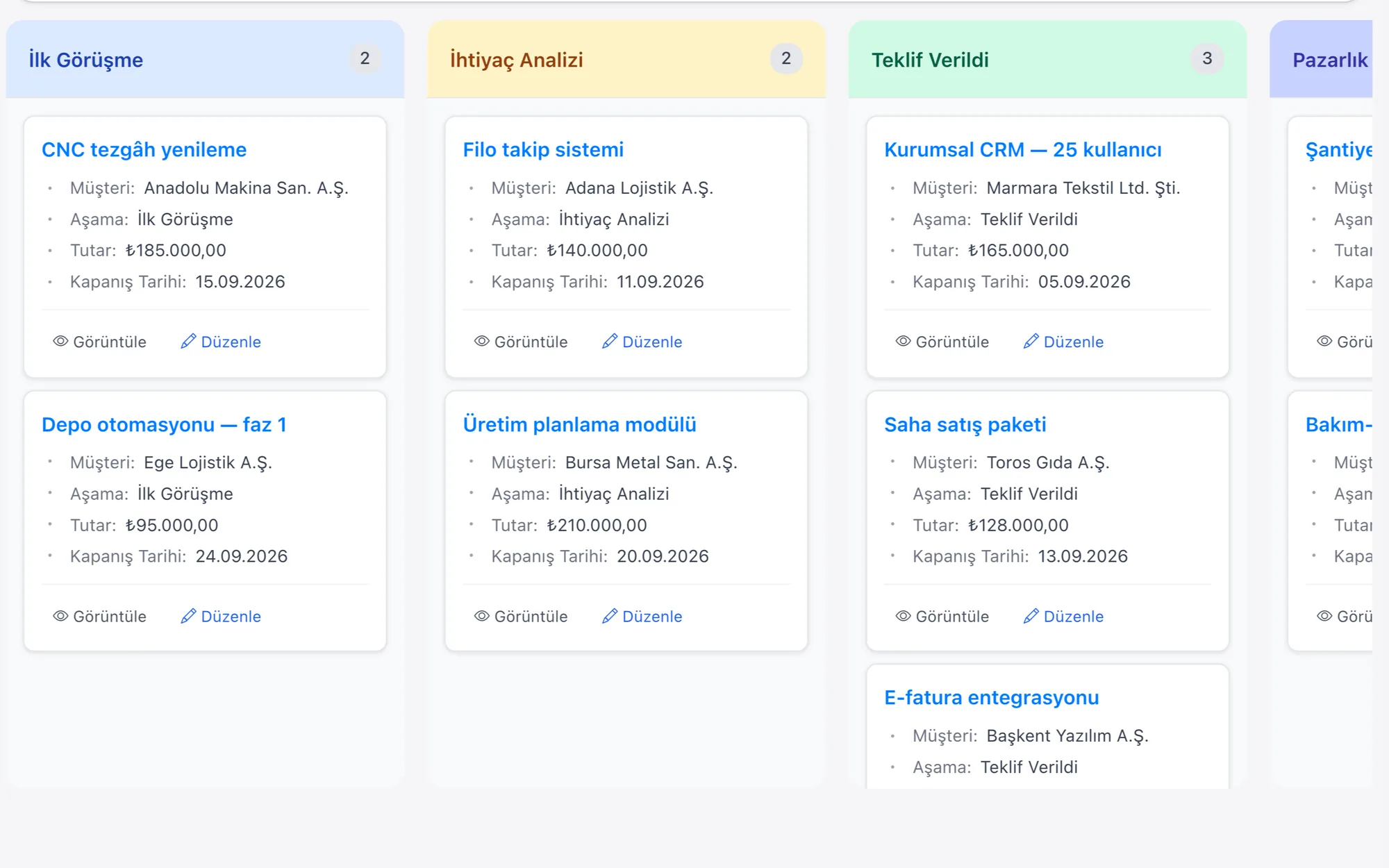
- Keep the quote's sent date and expected reply date in a field; let quotes whose reply is overdue fall into a list and make your calls from that list
- Record every extra request separately, keep the change cost in its own field and record the client's approval as a stage change
- Set up annual maintenance, server renewal and update reminders as tasks tied to the date field of delivered jobs
- Reply as a team from a single WhatsApp business number, assign conversations by the rule you define and monitor response times
| Weighted Sales Forecast | The amount and the stage of the opportunity are fields; the monthly projection comes out of a weighted report on those two fields, and no separate spreadsheet is kept. |
|---|---|
| Quote Tracking | The quote sits under the opportunity; the sent and reply dates are held in fields, and a follow-up task is opened for quotes whose reply is overdue. |
| Scope Creep Control | Every extra request is a separate record tied to the project record; its amount sits in its own field, and approval is recorded as a stage change. |
| Post-Delivery Revenue | A finished job is a closed record but it is not deleted; the maintenance and renewal reminder is set up as a task tied to the date field of that record. |
| Account Authorisation Line | The permissions opened to the agency on the client's control panel, server and ad account are lines tied to the project record; which account, who was authorised and on what date sit in fields, and when the job ends, revoking the permission is opened as a task. |
On a web job the scope does not grow in one go, but through three messages saying "let's add a small thing here too". Each one is unimportant on its own and none of them is written into the contract; added up, the delivery slips by two weeks and nobody notices, because it has not been measured anywhere.
In Rapitek CRM each of these messages opens its own record and goes to the client for approval with its added time and cost; project profitability stays visible while the work is still running. What comes after delivery is not left empty either. Renewal and maintenance reminders settle into the calendar as tasks tied to the date field of the closed job. On the quote side there is no guesswork either: the sent date and the expected reply date sit in fields, quotes whose reply is overdue fall into a list, and the follow-up call is made from that list.
