
An integration is not a logo list — it's a piece of work with a defined scope.
Rapitek CRM connects to your existing software through the REST API, webhooks and import/export; our professional services team builds the connection. This page lays out what is ready today, what gets built per project, and how the process works — as it is.
Why is there no logo wall on this page?
You won't find a wall of logos here. Instead, we spell out which connections are built in today, which are built per project, and how an integration job gets scoped.
You may be running Logo, Netsis, Mikro, Paraşüt, SAP or Odoo — ERP and accounting systems widely used in Turkey — and we have no out-of-the-box connector for any of them. We connect to all of them the same way: through the REST API, webhooks and import/export, delivered by our professional services team. That is not a gap; it is how the job actually works: two systems cannot talk reliably until the field mapping, flow direction, sync frequency and error scenarios are pinned down — and those differ at every company.
Across our founder's 200+ Salesforce projects, this was the most common work: getting two systems to talk. What that experience taught us is that an integration cannot truly be planned until the field mapping table exists. We produce that table ourselves during discovery and hand it to you in writing.
How does an integration project proceed?
-
1
Discovery
Which systems are in place, who owns the data, which data should flow which way? We look at your current Excel files and the other system's API documentation together. By the end of this call, the need is clear on both sides.
-
2
Scope and written quote
The field mapping table, flow direction, sync frequency, and error and duplicate scenarios are put in writing. Custom integration is a separate line item; you get its price and timeline in writing at this stage.
-
3
Development
The connection is built with the REST API and webhooks. Our professional services team does the development; from your side, system access and a point of contact are enough.
-
4
Testing and validation
Sample records are verified in both directions: does the account visible in the ERP match the CRM, and does a record created in the CRM appear correctly on the other side? Duplicate and error scenarios are exercised here.
-
5
Go-live and monitoring
The flow goes live and is watched through API usage analytics. When a field changes or a flow stops, you know exactly who to call: us.
What the REST API actually offers
Every object in a standard install
From leads to quotes, invoices to tasks, records are read and written through the REST API. Almost everything you see in the CRM is reachable from the API.
Access without sharing passwords
Access is granted with permissions, through standard authorisation (OAuth2). No integration is ever built by sharing a user's password.
Webhooks
Your system gets notified when a record is created or changed. The receiving system can verify the notification came from us and reject forged ones.
Field structure and combined requests
You can read the field structure of each record type from outside, and several operations can be sent in one request. Integration code doesn't have to track field changes by hand.
Import and export
Bulk data transfer works both ways via Excel/CSV. You can export your data and take it with you at any time — the data is yours.
Rate limiting and usage analytics
API traffic is protected by rate limits; usage analytics show how many requests each integration is making.
Built-in connections
| Connection | What it gives you | How it is set up |
|---|---|---|
| WhatsApp — Cloud API | Shared inbox: the team writes from a single business number and messages are logged on the customer record | Via Meta's official WhatsApp Business Cloud API; we connect your own WhatsApp Business account |
| Email sending | Send from your own Gmail or Google Workspace account inside the CRM; each email is attached to the related record | By connecting your Google account; the connection covers sending — your inbox is not read |
| Google Calendar | Two-way sync for appointments and events | Through a Google account connection, configured during setup |
| Import/export | Bulk transfer via Excel/CSV for the initial migration and for reporting | Built in; we handle the initial data migration during setup |
Index · ERP, email and messaging
ERP CRM integration
The frame that does not change whichever ERP you run: what stays where, how the connection is built, how scope is drawn.
SAP integration
We build it. Scope, method selection, and written answers to the security questions your IT team will ask.
Oracle integration
We build it — but only after clarifying which Oracle. “Oracle” is not one product, so the scope is set once that is clear.
Odoo integration
We build it. Because Odoo is open source and modular, the access question starts differently than with other ERPs; the page opens there.
Email integration
The canonical page for email: Gmail connects with your permission through Google, and the connection covers sending — the inbox is not read. Outlook and Microsoft 365 are not open today.
Google Workspace integration
Gmail and Google Calendar in one connection. Drive, Docs, Sheets and Meet are out of scope.
WhatsApp integration
The connection itself: Meta Cloud API, your own WhatsApp Business account — the number and the Meta invoice stay in your name.
Index · sales channels, team tools and AI
Shopify integration
We build it. Product, cart and payment run in Shopify; the buyer, repeat sales and wholesale requests are recorded in the CRM.
WooCommerce integration
We build it. Orders, payment and delivery run in WooCommerce; the buyer, quote requests and wholesale customers are recorded in the CRM.
Stripe and CRM
Amount, date and currency of the payment record move to the customer card over the REST API. The payment adapters defined in the product are iyzico and PayNkolay; there is no built-in Stripe adapter.
Slack integration
We build it. Outgoing webhooks, retry on failure and a notification node in the workflow engine already exist; we set up the subscription.
Microsoft Teams integration
The same notification infrastructure, aimed at a Teams channel. Outlook and Microsoft 365 email is not open today.
Zoom integration
You upload the call recording to the record; it is transcribed, and a summary and action items come out. Pulling the recording from Zoom automatically is separate work.
LinkedIn and CRM
Lead lists are loaded with Data Hub's four-step wizard and the profile URL becomes a field on the contact. We do not offer automatic pulling from LinkedIn.
Claude integration
Rapi, the assistant inside the product, and connecting your own Claude with the Rapitek connector.
ChatGPT integration
Our AI connector is designed to be added to ChatGPT (Developer Mode) as a custom connector through the open MCP standard; we set it up together with you.
Gemini integration
Gmail and Google Calendar work today. Our AI connector is designed to connect to Gemini CLI and Gemini Enterprise.
Two connections where we write today's status separately
Instagram DMs and comments. Instagram direct messages land in the same shared inbox as WhatsApp; the conversation is assigned and handed over the same way. Comment management is in place and verified end to end. This feature is new; if your decision depends on it, let's try it together in the demo. Because DMs and comment management stand at different points, we describe Instagram here rather than in the table above. For the scope and the current status, see our Instagram CRM page.
WhatsApp QR pairing. The same shared inbox can also be connected by pairing a phone via QR. This method is not Meta's official API and it carries the risk of the number being restricted by Meta; for that reason we do not offer it as a product promise — we recommend the official Cloud API instead. If you still prefer this route, we share the risk with you in writing and make the decision together.
Every record that comes from outside arrives with its source.
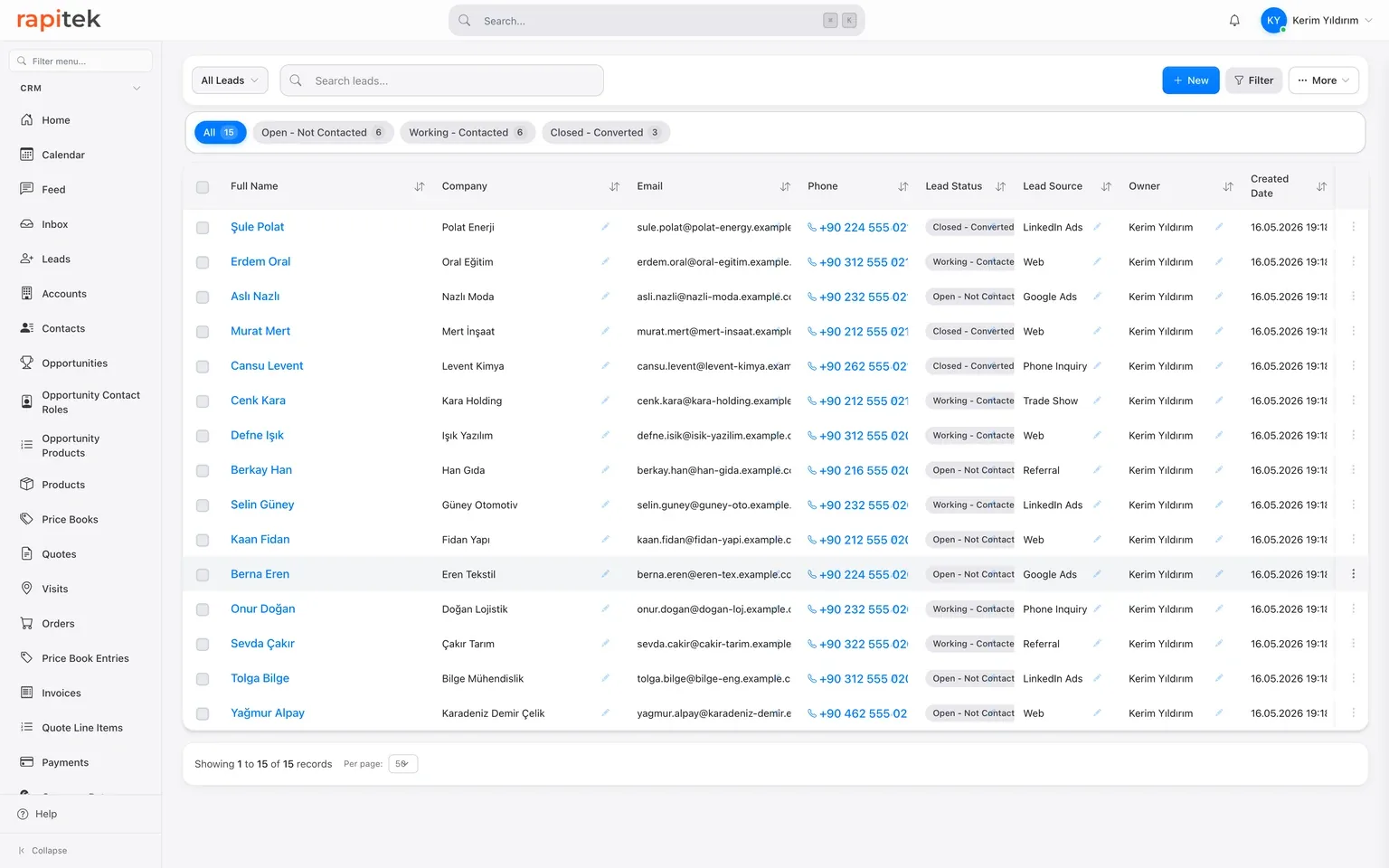
A form on your website or a portal you've connected through the API — whichever channel a record comes from, it lands in the lead list tagged with its source. You don't guess which channel actually brings business; you read it in a report.
A team that does this work, not just sells it
ERP and accounting: typical flows, timeline and cost
Typical flows
Across enterprise projects, four flows come up most often:
- Accounts and invoices from the ERP flow into the CRM, so the sales team sees the customer's commercial history on the customer record.
- Balances and collection status from accounting appear on the sales screen, so open balances are visible while a quote is being prepared.
- Leads from forms and portals land in the CRM tagged with their source.
- Calendars and appointments sync two-way with Google Calendar.
The first two are custom development per project; the last two use built-in connections.
Timeline and cost
The CRM rollout itself covers configuration, data migration and training; after the discovery call we give you a date, not a range, and its scope — along with any fee for it — is put in writing before the work starts. Custom work such as ERP and accounting integration is a separate line item: the scope is defined during discovery, and the price and timeline arrive as a written quote. Duration depends on the number of fields and on what the other system's API allows; we don't promise a timeline before discovery — we put one in writing after it. Plan details, and the items priced outside the plan, are on our pricing page.
Scope and setup conditions
| Area | Why | What we do instead |
|---|---|---|
| Real-time stock synchronization | The authority over stock records stays in your ERP or warehouse system. We cannot present a two-way live stock engine as a measured capability; if we did, it would produce two stock figures that disagree with each other in two systems | Which stock fields are carried into the CRM, and how often, is defined during discovery. What we recommend is a periodic visibility layer |
| Order, invoice and collection flowing on their own | The chain is built into the product and can be switched on or off per customer; but we do not think it is right for it to be sold as an automatic accounting flow. Producing official documents is not our job | The quote → order conversion runs as a built-in action; the invoice and collection steps are switched on optionally. The document is issued in your accounting or e-invoicing system, and its data is carried into the CRM |
| Production and MRP automation | Bill of materials, production line and work order screens exist in the product. Work order execution is new; if your process depends on it, let's try it together in the demo | Bill of materials and line definitions are set up, and the sales and quoting side runs in the CRM. We do not say that production planning is run by the CRM |
From our CRM implementation projects
As a former Salesforce user, getting to know Rapitek was an opportunity that opened the doors to different solutions for us. With the smart solutions their consultants provided, we significantly increased our efficiency. In addition, thanks to our collaboration with Rapitek, we seamlessly integrated our product with Salesforce and made our processes more efficient.
 Business Development Director · Iyzico

With Rapitek's solution-oriented approach, we started the necessary work to quickly complete improvements in our Salesforce customizations and integrations. With these improvements, we prevented data duplication and increased system efficiency.
 Sales Director · Petroyağ

Plan prices are published; project scope comes out of discovery
Connections that work on setup day are covered by your plan; the ones we build as a project are priced after the discovery call, in writing. We keep the numbers on one page.
Three plans, a scope table and separately priced items.
Frequently asked questions about integrations
Does Rapitek CRM integrate with Logo?
How does a connection to SAP, Netsis or Mikro work?
Can it connect to accounting tools like Paraşüt or Luca?
What do you offer for CRM API integration?
Do you support webhooks?
How does the WhatsApp connection work?
Is there two-way email sync with Gmail or Outlook?
Will forms on my website feed the CRM?
How long does an integration take?
Are integrations included in the plan price?
Can e-commerce platforms like Trendyol, Hepsiburada or Shopify connect?
Where is our data processed in integration traffic?
Let's scope your integration together
In a 30-minute intro call we show the API, the WhatsApp connection and the typical flows for your systems — on your own scenario. At the end of discovery you get the scope and timeline in writing. Then we open your 7-day trial account; no credit card required.
