
Home Healthcare CRM
The service is delivered in the patient's home, that is, somewhere the manager cannot see; whether the visit actually happened and what was done that day is only discussed when a family member asks.
A visit is a record with carer, patient and time fields — its start is recorded with time and location verification. A care plan item that is skipped stays open on the visit.
- Match the most suitable carer to the patient's needs
- Plan the daily visit schedule and verify the time and location of the visit at the moment it is recorded
- Record the detail of every visit and produce a periodic progress report
- Send the daily care report and visit notification to the patient's family over WhatsApp
- Follow visit timing and care quality scores per carer
| Patient-Carer Matching | Needs and competencies are fields on the patient and carer records; a suitable carer is chosen from a list filtered on those fields, and the assignment is recorded. |
|---|---|
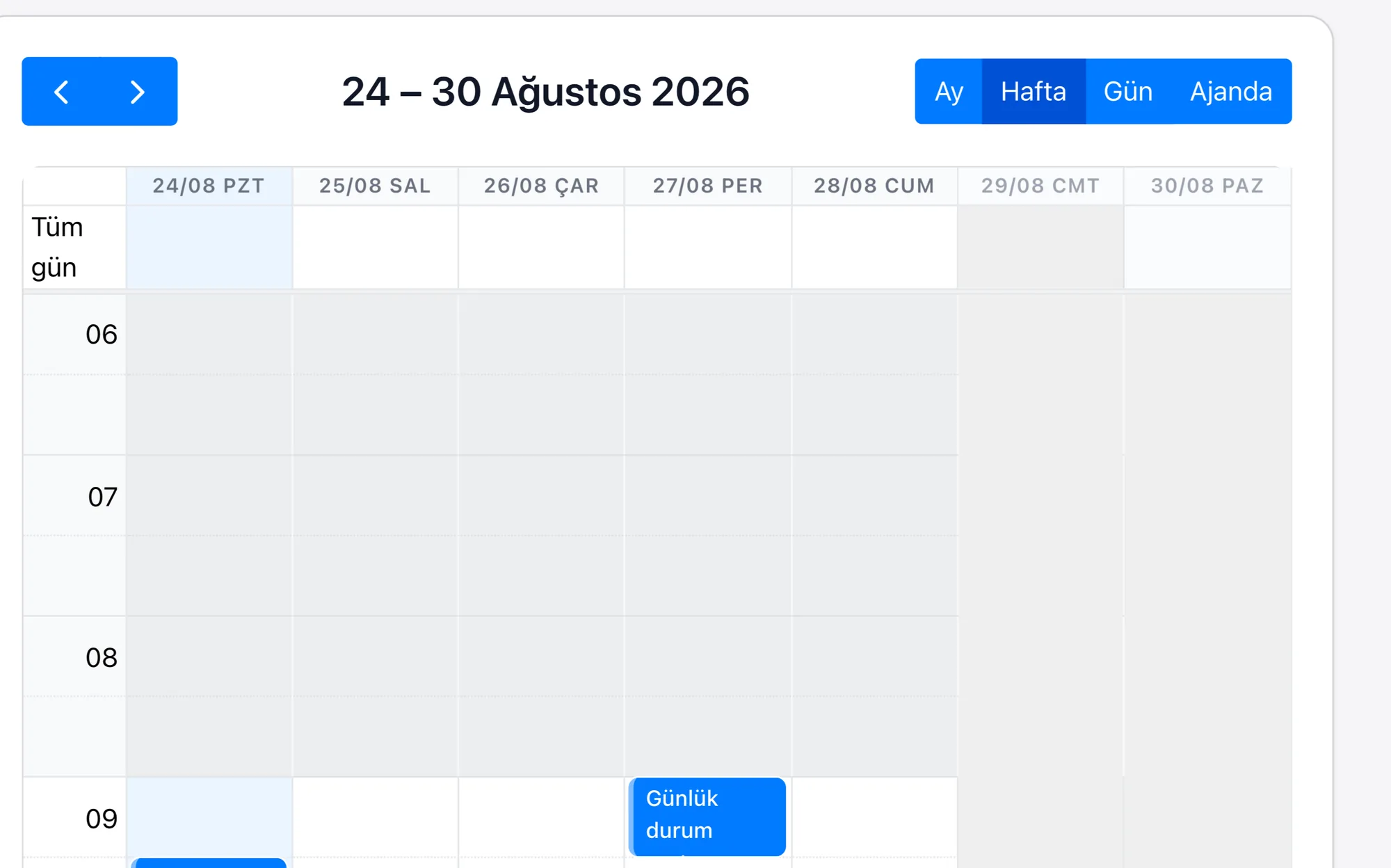
| Visit Planning and Tracking | A visit is a record with carer, patient and time fields; the start and end are kept together with their times, and the plan is visible on the calendar. |
| Family Communication Centre | A patient's relative is a contact record tied to the patient card; who was told what and when leaves a trace on the same card. |
| Care Quality Reporting | Because the note from every visit sits on its own record, the periodic progress report is compiled from those records and no separate logbook is kept. |
| Medication Times and Care Plan | The patient's medication times and care plan items are sub-lines on the patient record; each item is ticked off one by one during the visit, and an item that is skipped stays open on the visit record and drops onto the office's list. |
In home healthcare the place where the service is given and the place where it is managed are not the same. The carer goes to the house alone in the morning and describes what happened in the evening; if the patient's condition changes between two visits, neither the office nor the family learns of it in time. When a carer leaves, the person who replaces them has to learn the patient's medication times, habits and limitations from scratch.
Because Rapitek CRM records every visit with time and location verification, the difference between what was planned and what actually happened becomes visible at the office. Since visit notes accumulate on the patient card, the care history is open to the new person even when the carer changes. Because the report produced from those same records goes to the patient's family regularly, their need for information is met without them having to ask. Health data is kept in a database separated per tenant. We build the connection to SGK or insurance institutions; there is no out-of-the-box module. As long as the connection is not built, authorisation and entitlement information is recorded by hand or with an import file, and invoicing and payment tracking run over those records; if a connection is wanted, it is built over the REST API within the scope of the project.
