
AI Services CRM
When you sell an artificial intelligence solution there are two long steps before signature: permission to access the customer's data, and what the pilot is going to prove. When those two are discussed over email and written into no field, the two sides do not give the same answer to 'was it a success?' once the pilot ends.
Data access permission, the non-disclosure agreement and the pilot's success threshold are fields on the opportunity record; until approval is complete the opportunity does not move on.
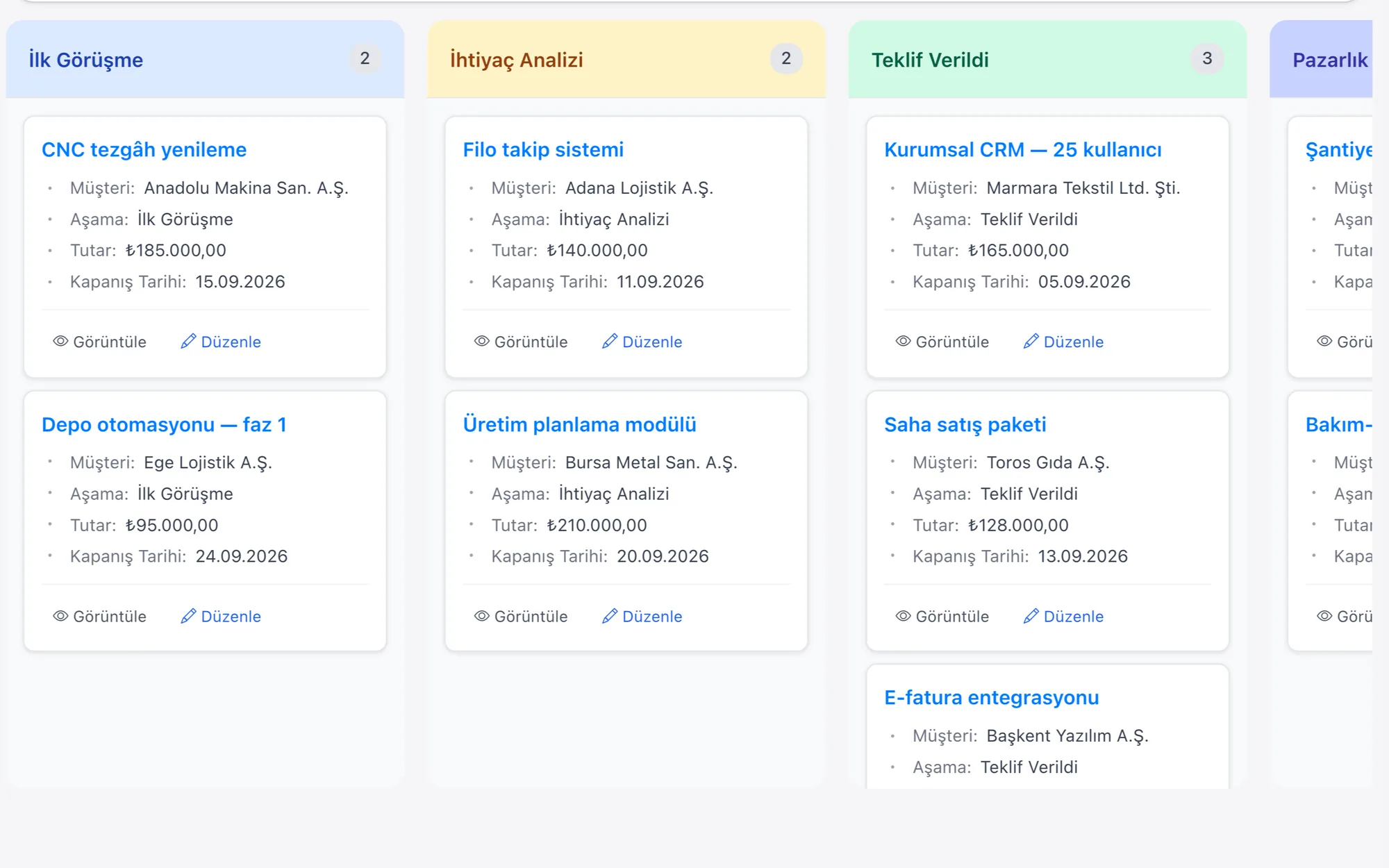
- Run the proof of concept with its own stages; keep data access permission and the status of the non-disclosure agreement in fields on the opportunity record
- Tie the pilot's success threshold to a written field so that when the result arrives both sides look at the same criterion
- Keep the legal, information security and business unit stakeholders in separate contact records and see from the list which approval is waiting with whom
- Manage the long evaluation period with a contact sequence; keep usage volume in an account field and tie the renewal conversation to it
| Proof of Concept Opportunity | The pilot is an opportunity record with its own stages; the start date, the scope and the success threshold are in its fields, and the result stays on the same card. |
|---|---|
| Data Access and Confidentiality | The non-disclosure agreement and data access permission are each a field; the signature date and the scope sit in the record, and a missing approval does not let the opportunity move to the next stage. |
| Stakeholders and the Approval Queue | Legal, information security and the business unit are separate contact records under the account; a pending approval is a task and its owner is written in its field. |
| Usage and Renewal | Usage volume is a field on the account; as the contract end approaches, the renewal task drops onto the list and the expansion opportunity is opened from the same account. |
In a company working in the artificial intelligence field, the sales cycle moves forward on a technical proof. The customer first asks for a proof of concept; for that they have to share their own data, and that sharing means a non-disclosure agreement, an information security review and legal approval. Every step sits with a different stakeholder: the data owner is in the business unit, the permission is with legal, the infrastructure question is with IT. The pilot's success threshold, meanwhile, is discussed in a meeting and rarely written down. When the result arrives, the criterion each side remembers does not match, and the contract discussion starts over. The work does not end after the sale either; because usage volume and credits consumed determine the invoice, how much the customer is using is discussed regularly.
In Rapitek CRM the proof of concept is an opportunity record with its own stages: data access permission, the status of the non-disclosure agreement, the pilot start date and the success threshold are fields on that record. The legal, information security and business unit representatives are separate contact records under the account; which approval is waiting with whom is read from the list. Because the evaluation takes a long time, a contact sequence can be defined and follow-up tasks drop in accordingly, so through months of silence it is never forgotten who is due a call. Usage volume is a field on the account; as the contract end approaches, the renewal task drops onto the list and the expansion opportunity is opened from the same account. We build the connections on the billing or infrastructure side ourselves; there is no out-of-the-box module, and the connection is built specifically for the project over the REST API covering 183 business objects, OAuth2 and webhooks.
What the plans cover and which items are priced separately are written on the pricing page.
