
Enterprise Manufacturing CRM
A corporate manufacturer sells the same product to the dealer, to the distributor and directly to the corporate buyer on different terms; and on top of that the sale is met from more than one plant. When which customer buys from which price list and which plant they are tied to is not visible in a single table, the quote diverges from channel to channel.
The plant, channel and price list are fields on the account record; a quote line's unit price is not typed by hand but comes from these fields. Sample and framework contract have their own records.
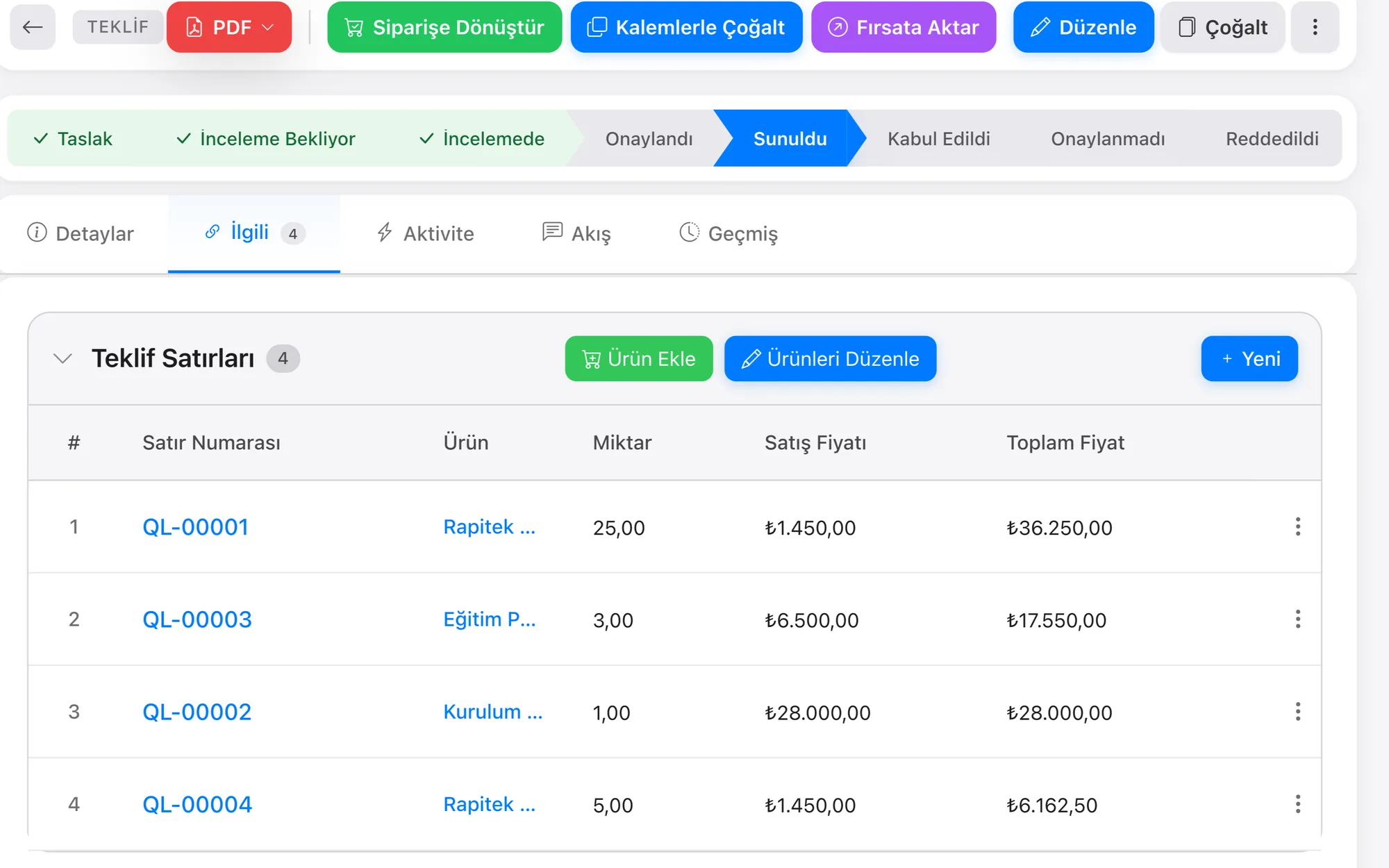
- Define dealer, distributor and direct corporate buyer as separate channels and tie each channel to its own price list
- Gather the requests of several plants in a single pool and track from the record which job is tied to which plant
- Run the sample request through its own stages; keep the approval or the reason for rejection on the customer record
- Keep the annual commitment and the end date of framework contracts as fields and tie renewals coming due to a task
| Multi-Channel Customer Structure | Dealer, distributor and direct buyer are different channel values of the same account object; the price list is tied to that field and comes onto the quote from there. |
|---|---|
| Multi-Plant Request Distribution | An incoming request is a record; the plant field and the assignment rule defined during setup drop the request to the team of the relevant plant, and the jobs waiting in the queue are read from a list. |
| Sample and Approval Process | A sample request is a record with its own stages; the dispatch date, the result and the reason for rejection are its fields, and the history stays on the customer card. |
| Framework Contract Tracking | A contract is a record tied to the account; the annual commitment, the price validity and the end date are fields, and endings coming due fall into a list. |
At a multi-plant manufacturer the customer relationship does not fit into a single sales representative: the same group buys one product from one plant through the dealer channel and another product from a different plant directly. The sample request sits with the quality unit, the annual commitment of the framework contract in the sales manager's spreadsheet, and the delivery date promise in planning. When the customer says "last time we talked about this price", which list of which channel they are talking about is not clarified the same day; this uncertainty is not specific to sub-sectors, it comes from the same place at every multi-channel manufacturer.
In Rapitek CRM the customer is a single account record; the plant, the channel and the price list are fields on that record, and the quote price comes from these fields instead of being typed by hand. A sample request is a record that moves through its own stages; the approval or the reason for rejection stays on the same card. Because the commitment and the end date of the framework contract sit in fields, renewals coming due fall into a list. We build the connection on the ERP side ourselves; there is no out-of-the-box module, and the Logo, Netsis, Mikro or SAP connection is set up specifically for the project over REST API, OAuth2 and webhooks.
The scope of the plans and the separately priced items are written on the pricing page.
