
What Is a Customer?
- Category
- CRM
- Publish date
- April 22, 2025
- Related article 1
- History of CRM: From the Rolodex to AI
- Related article 2
- Choosing a CRM: The Questions That Actually Decide the Outcome
- Related article 3
- Lead Management: From First Contact to a Qualified Opportunity
Who counts as a customer, how do customers differ from consumers, and what types are there? From the B2B/B2C distinction to segmentation, the customer lifecycle and CRM: a complete guide.
Contents
Introduction: Why the Customer Concept Is Critical for Business
The customer is one of the foundation stones of business success, and in today's competitive markets the concept matters more than ever. In its simplest form, a customer is a person or organization that purchases goods or services from a business. In modern business practice, however, the concept carries a strategic weight that goes far beyond this simple definition.
That is why a deep understanding of who customers are, what types exist and why they matter is the first step in building a successful business strategy. Customer-centric thinking is the common trait of today's companies that keep their customers.
In this guide we look at the different dimensions of the customer concept, examine customer types, and explain why effective customer relationship management is vital for any business. If you are starting customer relationship management from scratch, our step-by-step CRM guide is a good companion read.
In modern marketing and sales strategy, concepts such as customer experience, customer satisfaction and customer loyalty play a central role. Businesses no longer simply sell products or services. They build long-term relationships with their customers to achieve sustainable growth.
Customers are the reason a business exists. Without them, no commercial activity is sustainable.
Customer Definition and Core Characteristics
The Traditional Definition
Traditionally, a customer is an individual or corporate buyer that purchases goods or services from a business. This definition centres on the moment of the transaction: the act of buying. Today the definition has broadened considerably.
In modern business, a customer is anyone who interacts with the company, exchanges value with it, and contributes directly or indirectly to its success. This wider view may include active purchasers, prospects who have shown interest but not yet bought, past customers who may return, and advocates who recommend the brand without being paid to. It is this broader perspective that brings the customer lifecycle into focus.
Customer vs. Consumer: What Is the Difference?
The terms customer and consumer are often used interchangeably, but there is an important distinction. The customer is the person or organization that makes the purchase; the consumer is the person who actually uses the product or service. When a parent buys a toy for their child, the parent is the customer and the child is the consumer. In many everyday purchases the customer and the consumer are the same person, but in B2B scenarios and gift purchases they are often different.
Core Characteristics of a Customer
Has a need
Customers engage with businesses to satisfy specific needs
Makes decisions
They play an active role in the buying process and set their own preferences
Expects value
They expect satisfying value in return for what they pay
Judges the experience
They evaluate the entire buying experience, not just the product
Builds relationships
They have the potential to develop long-term relationships with a business
Types of Customers and Segmentation
Customer Types by Demographics
Classifying customers by demographic characteristics is critical for building effective marketing strategies. This segmentation approach helps businesses understand their target audiences far better.
Individual customers (B2C):
- By age group: young, middle-aged and senior customers
- By income level: low, medium and high income
- By education: primary, secondary and university graduates
- By lifestyle: traditional, modern, technology-driven
B2C customers typically have shorter decision cycles, are influenced by peer reviews and social media, and expect personalized experiences and quick service.
Corporate customers (B2B):
- By company size: SMEs, large enterprises, multinationals
- By industry: technology, healthcare, finance, manufacturing, education
- By geography: local, national, international
B2B buying involves longer decision processes with multiple stakeholders, a focus on ROI and business value, and relationship-based transactions that require detailed product information and support.
Customer Types by Buying Behaviour
How customers buy shapes a company's sales and marketing strategy, and this classification is essential for optimizing the customer experience.
By purchase habit:
- New customers: buying for the first time
- Repeat customers: buying regularly
- Loyal customers: committed to the brand over the long term
- Advocate customers: recommending the brand to others
Segmenting Customers by Profitability
Not all customers are equally valuable to a business. Profitability analysis supports strategic decisions about where to invest resources:
- Gold customers: high profitability, low cost to serve
- Silver customers: medium profitability, standard service needs
- Bronze customers: low profitability, high cost to serve
- Loss-making customers: unprofitable and expensive to serve
The Customer Lifecycle
-
1
Awareness
A potential customer discovers your brand or solution for the first time.
-
2
Consideration
The prospect evaluates your offering against the alternatives.
-
3
Purchase
The decision is made and the first transaction takes place.
-
4
Onboarding
The new customer is introduced to your product or service and starts seeing value.
-
5
Retention
Ongoing engagement and value delivery keep the relationship alive and encourage repeat business.
-
6
Advocacy
Satisfied customers become ambassadors who recommend you to others.
Customer Relationship Management and Why It Matters
The Role of CRM Systems
Today, customer relationship management is unthinkable without technology. A CRM (Customer Relationship Management) system gathers customer data on a central platform, so a business can analyse it and deliver personalized experiences at every stage of the lifecycle described above.
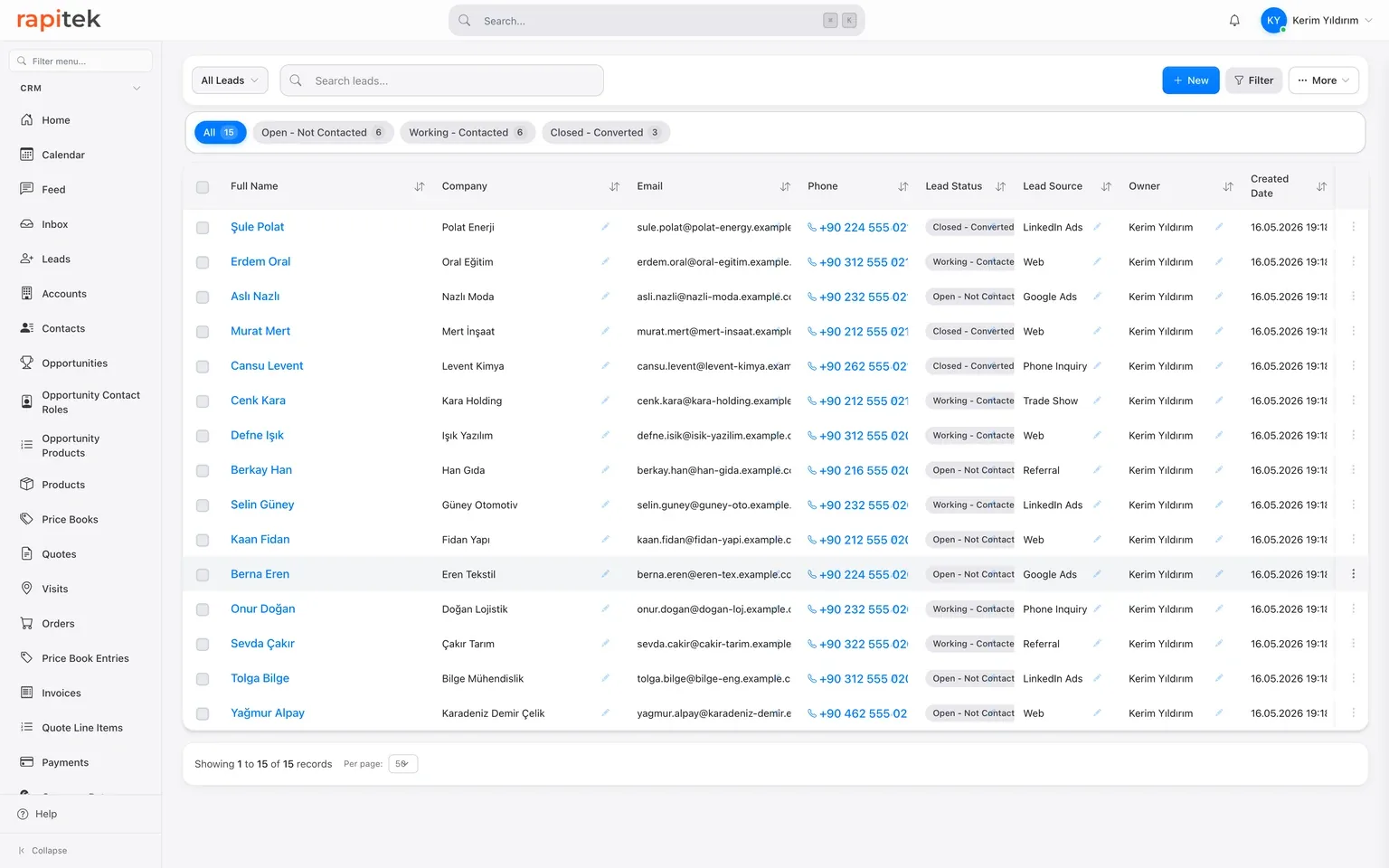
Modern CRM platforms provide valuable insight at each of those stages: from the first enquiry to long-term advocacy. To keep each customer's stage, conversations and quotes on one record, see Rapitek CRM: we set it up for your team, and you can try it free for 7 days.
Customer Satisfaction and Loyalty
Customer satisfaction expresses how well a product or service meets customer expectations. Loyalty goes beyond satisfaction: it is the emotional bond that ties a customer to a brand.
What drives customer satisfaction:
- Quality products and services
- Fast, effective customer service
- Personalized experiences
- Transparent, trustworthy communication
- Quick resolution of problems
- Regular customer surveys that feed back into decisions
Optimizing the Customer Experience
Customer experience is the customer's total perception across every point of interaction with a business. Optimizing it requires an omnichannel approach: physical locations, website, mobile app, social media and customer service all need to deliver one consistent experience.
The Strategic Importance of Customers
Impact on Revenue and Profitability
Customers are a company's primary source of revenue, but the story goes further. Customer Lifetime Value (CLV), the total revenue a customer is expected to generate over the entire relationship, is critical to long-term strategic planning. A loyal customer can keep generating revenue for years.
Winning a new customer costs materially more than keeping an existing one: advertising spend, sales effort and a lower conversion rate all stack up. The widely quoted "X times more expensive" multipliers mostly trace back to no verifiable source, and they do not describe your business. Work out your own figure instead: calculate your customer acquisition cost (CAC) and compare it with what retention costs you. The gap tells you how much budget retention deserves.
Brand Image and Reputation
Satisfied customers are a company's voice outside its own channels. In the social media age, one customer's experience can influence thousands of potential customers. Positive experiences feed organic, word-of-mouth growth.
The Customer's Role in Innovation
Customer feedback is an indispensable input to product and service development. Understanding customer needs, and anticipating future demand, is a durable source of competitive advantage.
Conclusion: The Future of Customer-Centric Business
The customer sits at the centre of modern business. Beyond a simple buyer–seller relationship, customers act as strategic partners, sources of innovation and brand ambassadors. Defining customers correctly, segmenting them well and building effective relationships with them is a fundamental condition of sustainable business success.
In today's digital environment, customer relationship management depends on technology. CRM platforms, data analytics and AI-supported tools let businesses optimize the customer experience end to end. At Rapitek, we draw on our founder's experience across more than 200 Salesforce projects to help businesses manage customer relationships strategically.
Adopting a customer-centric approach means looking beyond short-term sales targets and focusing on long-term customer value. Customer satisfaction, loyalty and advocacy have become core performance indicators of modern business.
The successful businesses of the coming decade will be the ones that put customer experience at the centre, personalize at scale and keep learning. If you want technology on your side in that transformation, take a look at what Rapitek CRM offers.
Scope and setup conditions
This is a concept article, not a product pitch for Rapitek CRM. What follows is where the expectations this topic raises actually stand with us.
- There is no module that builds your customer segmentation for you. You define the segment; the CRM applies that definition and repeats it. Fields and objects can be added without writing code.
- There is no box that calculates CLV or CAC for you. The inputs to both numbers sit in your own accounting and marketing data; the CRM reports them, it does not produce them.
- There is no rule-based assignment that advances the lead status or the opportunity stage by itself. The assignment-rule object exists; this feature is new, so if your decision depends on it, let's try it together in a demo. Your team, or a workflow you define, moves the status and the stage.
- Your CRM data is kept in a separate database that belongs to you: separate table files, a separate backup and separate file storage. That separation is at the database level; the application chooses which customer's database each request goes to.
- There is no permanent free plan. You can try it free for 7 days; we start with a 30-minute intro call.
Frequently Asked Questions
What is the difference between a customer and a consumer?
What do B2B and B2C customers mean?
What are the main types of customers?
What is Customer Lifetime Value (CLV)?
What are the stages of the customer lifecycle?
Know every customer on one platform
Built on our founder's experience across more than 200 Salesforce projects, Rapitek CRM is configured to the way your team works, and we do the setup. Then we open your 7-day trial account; no credit card required.

Kerim Yıldırım
Founder, Rapitek CRM · 200+ enterprise CRM projects during our Salesforce era
