
Lead Management: From First Contact to a Qualified Opportunity
- Category
- Guide
- Publish date
- Aug. 2, 2026
- Related article 1
- Choosing a CRM: The Questions That Actually Decide the Outcome
- Related article 2
- What Is a Customer?
- Related article 3
- Pharmacy Inventory Management: FIFO, Expiry Tracking & Audit Trail
A form gets submitted at 14:12. The reply goes out the next morning at 09:40. In between, the buyer has already opened three other vendor sites, sent two more forms, and started forming an opinion about what a good answer to their problem looks like. The deal is not lost yet, but the frame has been set by someone else.
Lead management is the set of rules that decides what happens in those hours. Not a philosophy. Rules: who owns the record, what has to be true before it moves forward, what the second message says, when the file gets closed. Below is how we structure it, based on our founder's experience across 200+ Salesforce projects, plus the part most English-language guides skip entirely: what Turkish law requires when you collect those leads through a form.
An autoresponder is not a response; it is a receipt.
Contents
A lead is not an opportunity
A lead is an unverified claim of interest. Someone typed a name into a box. It may be a buyer, a competitor, a student writing a thesis, or a person who wanted the PDF.
An opportunity is different in kind, not in degree. It has a named company, an identified problem someone inside that company wants solved, a person who can talk about money without leaving the room, and a plausible time frame. Everything before that is research.
The distinction matters because it decides what your pipeline number means. If leads and opportunities share one bucket, your forecast is a wish list and your conversion rate has no denominator you can trust. Make the transition an explicit, dated event with written criteria: a stage change someone performs on purpose, not a field that drifts.
A workable conversion rule: you can name the company and the role of the person, you understand the problem in their words, you know who else is involved in the decision, and there is an agreed next step with a date on it.
- Lead: interest claimed, nothing verified.
- Marketing-qualified: fits your target profile on paper.
- Sales-qualified: a human has spoken to them and the problem is real.
- Opportunity: named need, identified decision-makers, next step with a date.
Qualification frameworks: use one, do not worship it
BANT asks about Budget, Authority, Need and Timeline. It is fast and it fits shorter, more transactional cycles. Its weakness is the ordering: asking about budget first assumes a budget already exists. In the mid-market Turkish companies we have seen it usually does not: the budget gets created after someone builds an internal business case, and often the person you are talking to is the one who will build it.
MEDDIC asks about Metrics, Economic buyer, Decision criteria, Decision process, Identified pain and Champion. It is built for long, multi-stakeholder deals where the risk is not losing to a competitor but losing to indecision. It costs more discovery time, and on a two-week cycle it is overkill.
Need-first variants such as CHAMP reorder the same questions to start with the problem. None of these is correct in the abstract. A framework is not a script: it is a checklist of things you do not know yet.
Two practical rules. First, pick one and write down what each letter means in your own business, in your own words; "Authority" in a 40-person distributor means something different than in a bank. Second, put the fields in the CRM so the answers are inspectable by someone other than the rep. A framework that lives only in a salesperson's head is a personality, not a process. And if two people on the same team use two different frameworks, you have neither. You cannot compare their pipelines.
Scoring: a rule you can read out loud
Keep two axes separate: fit (who they are) and engagement (what they did). A very engaged bad fit and a barely engaged perfect fit are not the same object, and collapsing them into one number hides exactly the thing you need to see.
Fit signals are structural: sector, company size, how many people are actually in the sales team, whether there is a field team, how many locations the work runs from, what they use today. Engagement signals are behavioural: a demo request weighs more than a newsletter sign-up, a reply to a message weighs more than a page view, a booked meeting outweighs both.
Negative scoring matters as much as positive. Job applications, student research, competitor domains, free mail addresses with no company name, countries you do not serve. Subtract, and route them out of the sales queue.
Calibrate against reality, not opinion. Take last year's closed-won and closed-lost deals, run your proposed rule backwards over them, and see whether it would have ranked them correctly. If it would not, the rule is wrong. Review it quarterly, because your ideal customer moves.
One caution: a score is a queue order, not a verdict. Auto-discarding low scores is how teams quietly delete their own market.
Routing: one owner, within minutes
Every lead needs exactly one named owner, assigned automatically, fast. Shared inboxes and "whoever sees it first" are not routing rules; they are a way of guaranteeing that busy periods get the worst service.
Choose a basis and write it down: round robin, territory, sector specialisation, or company size. Weighted round robin with capacity caps works well when reps have unequal loads. Whatever you pick, add the two rules people forget:
- Fallback: if the owner has not touched the record within a set number of minutes, reassign it automatically.
- Escalation: if it is still untouched after a second threshold, notify a manager, quietly, in a channel, not as a public shaming.
- Out-of-hours: decide in advance who covers evenings and weekends, and what an acceptable holding reply looks like.
Also deduplicate before you create. Check email domain and phone number against existing records at the moment of submission. Merging duplicates three months later is where the history dies: two owners, two versions of the story, one annoyed buyer who has explained the same thing twice.
Owner, source and status, on the record itself
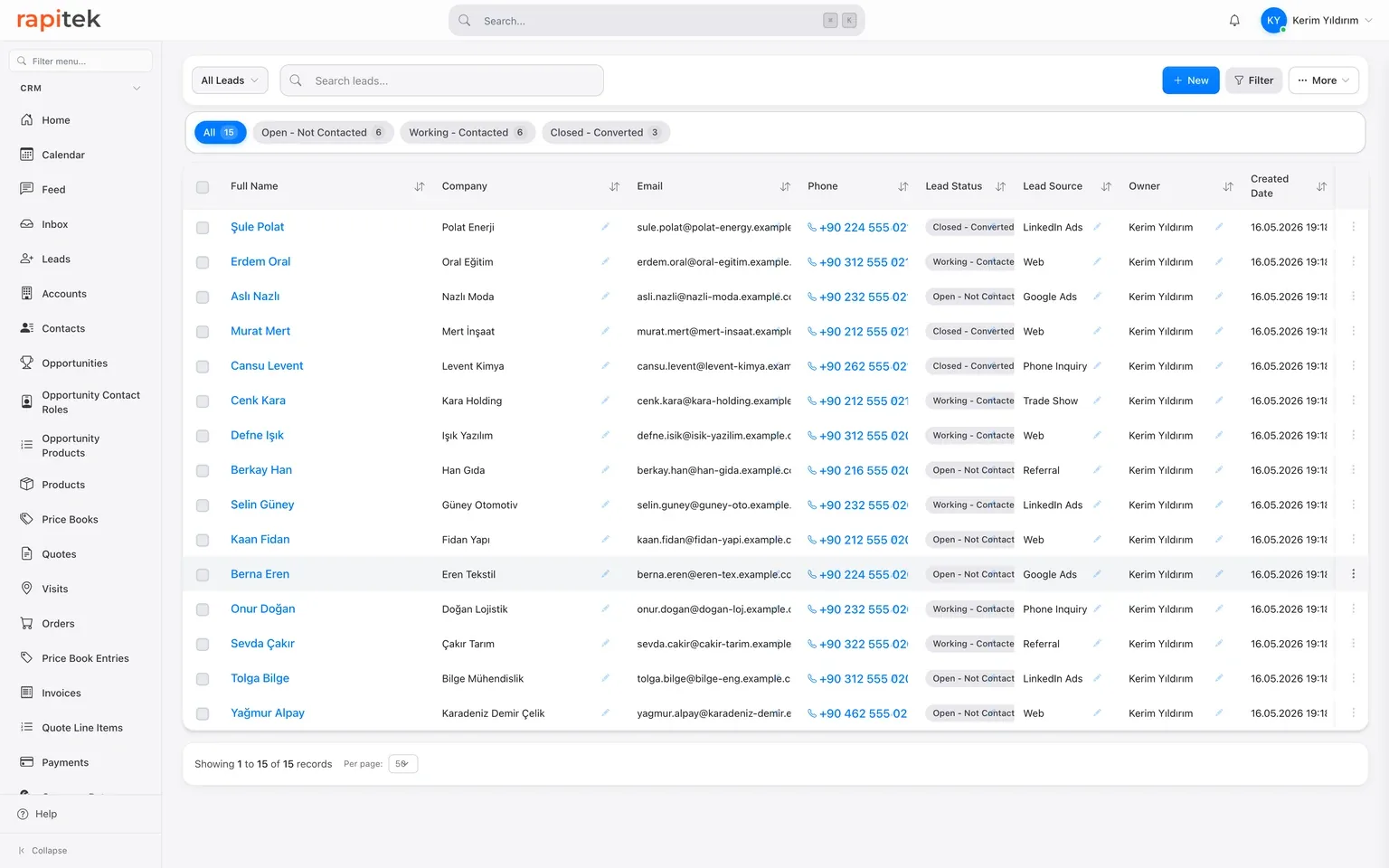
The Leads screen in Rapitek CRM: status chips for Open, Working and Closed, the lead source and owner fields, the date each record was created, and filter chips at the top that carry their own counts.
Why first response time decides more than the pitch
We deliberately will not quote a statistic here, because the mechanism is more useful than a number someone else measured on someone else's market.
When a person submits a form, they are in an active decision window that they opened themselves. They have context loaded: the problem is on their screen, the alternatives are in open tabs, and they are willing to talk. That window closes on its own. Reach them inside it and you are having a conversation. Reach them two days later and you are interrupting a different task, and the criteria they will judge you by have already been written, usually by the vendor who answered first.
Measure first response as the first meaningful contact by a human. And measure the tail, not the average: a p90 of eleven hours with a two-minute average tells you the truth that "average 40 minutes" hides.
In Turkey the channel that closes this gap in practice is WhatsApp. A short message that uses the person's name, refers to what they actually asked about, and offers two specific times tends to do better than a formal email with an attached brochure. Keep the first message under five lines and end it with one question.
Follow-up cadence: written down, or it does not exist
A cadence is a specific answer to four questions: how many touches, over how many days, on which channels, carrying what content. Without those four, "we followed up" means whatever the rep felt like doing that week.
A reasonable starting cadence for an inbound demo request: contact within minutes on the channel they used; a second touch the same day on a different channel; then spaced touches over the following two weeks, alternating channels. Adjust to your cycle length, not to a template you read.
The rule that actually changes results: every touch must add something the previous one did not. A relevant example from their sector, a specific question about their process, a short note on how the setup would work for a team their size. "Just following up" adds nothing and trains people to ignore you.
Have a stop rule. After the cadence ends without a reply, move the record to nurture with a dated re-entry. Do not leave it open. Leads that stay open forever inflate your pipeline and destroy your ability to read conversion rates.
Log every touch in the CRM, not in someone's personal phone. Two reasons: when that person leaves, the relationship history leaves with them; and under KVKK, personal data sitting in a private handset with no record, no retention period and no access control is its own problem.
Collecting leads in Turkey: KVKK, explicit consent and İYS
A lead form is a personal data collection point. Three obligations apply, and the most common mistake is merging them into one checkbox.
1. The privacy notice (aydınlatma metni). Under Article 10 of KVKK (Law No. 6698), you must inform the person at or before the moment of collection, regardless of which legal ground you rely on. The Communiqué on the obligation to inform sets out the required content: the identity of the data controller (and representative, if any), the purposes of processing, to whom and for what purpose the data may be transferred, the method and legal ground of collection, and the person's rights under Article 11. This is a standalone text, readable before submission. Version it and archive each version.
2. The legal ground. You do not automatically need consent. Responding to a demo request can rest on the pre-contractual ground in Article 5/2-c or on legitimate interest in Article 5/2-f. Consent is the correct ground for later marketing use, not for answering the question the person asked you. Bundling everything into a single "I accept" box weakens the whole structure, because explicit consent must be freely given and specific to a defined subject. If the form will not submit without the marketing box ticked, that consent is not freely given.
3. İYS for commercial messages. Under Law No. 6563 and the regulation on commercial electronic messages, marketing sent by messaging apps requires the recipient's prior approval; for SMS, email and phone calls the same prior approval is required, and that approval must be registered in the İleti Yönetim Sistemi (İYS) within three business days. If the address is not in İYS when you send, the message is treated as sent without consent. Opt-out must be free and must be actioned within three business days. The approval regime differs for recipients who are traders (tacir/esnaf), but registration and opt-out handling still apply. Confirm your own case with counsel.
4. Cross-border transfer. If your CRM, email platform or support tool runs on servers outside Turkey, that is a transfer under Article 9, which was amended by Law No. 7499 in 2024. The routes are an adequacy decision, appropriate safeguards such as standard contractual clauses (which must be notified to the Board within five business days of signing), or, for occasional transfers, a separate, standalone explicit consent obtained after the person has been informed of the risks. "Separate" is the operative word: it cannot be folded into the general consent line.
We apply this to ourselves. Rapitek CRM's database runs in the EU (Helsinki, Finland) and media storage in Frankfurt, Germany. That is a cross-border transfer under Article 9, we say so in our own notice, and we do not claim otherwise.
5. Evidence. Store what you would need to prove consent a year later: the exact version of the text displayed, timestamp, IP address, the state of each checkbox, and the İYS transaction reference. If you cannot reconstruct what the person saw that day, you cannot demonstrate consent.
6. Retention. Dead leads are not a keepsake. Set a written retention period, run periodic deletion, anonymisation or destruction, and check whether you have a VERBİS registration obligation. A CRM full of eight-year-old untouched leads is both a compliance exposure and a source of bad metrics.
What to measure
Measure the funnel and the hygiene separately. The funnel tells you how the business is doing; hygiene tells you whether the funnel numbers are real.
Funnel
Leads by source · qualified rate · lead-to-opportunity conversion · opportunity win rate · pipeline created per source.
Speed
Time to first human contact (p90, not average) · time from lead to opportunity · number of touches before the first meeting.
Quality
Demo no-show rate · rate of leads disqualified after the first call · cost per qualified lead if you are paying for traffic.
Hygiene
Percentage of leads with an owner inside your target window · percentage with the source filled in · percentage with a dated next step.
One warning from our own logs: form counts and search impressions are inflated by bots. We once traced a large batch of submissions on one of our own English pages to automated traffic, not people. Before you judge a channel on volume, separate the real submissions from the noise; otherwise you will fund the wrong source and starve the one that actually produces meetings.
Review response time and stuck leads weekly. Review conversion rates monthly. Anything reviewed less often than that turns into decoration.
Frequently asked questions about lead management
What is the difference between a lead and an opportunity?
Which qualification framework should I use: BANT, MEDDIC or something else?
How quickly should we respond to an inbound lead?
What does KVKK require when I collect leads through a form?
What is İYS and does it apply to my lead follow-up?
Where to go from here
If you want to see this running rather than read about it, you can try it free for 7 days; we start with a 30-minute intro call. We will walk through your actual lead flow (form to owner to cadence) and show how it looks in Rapitek CRM, including the consent fields and the İYS sync, which runs when you connect your own İYS account through Verimor.
You can also reach us on WhatsApp: +90 212 963 22 84. That is a WhatsApp line, and it goes to the founding team during business hours; there is no ticket queue in between.
Two notes. Our team prepares and opens your trial account after the intro call, with no credit card required. Setup is customisation-first and covers data migration and training; after the discovery call we give you a date, not a range. Rapitek CRM is designed for teams of roughly five sales users and up. And WhatsApp is not an add-on for us; it sits in the middle of the lead workflow, which is where it sits in most Turkish sales teams already.
Try it with your own lead flow
In a 30-minute introductory call we listen to how your leads arrive and who follows them up. Then we open your 7-day trial account; no credit card required.

Kerim Yıldırım
Founder, Rapitek CRM · 200+ enterprise CRM projects during our Salesforce era
