
Skip to content

Electricity Distribution CRM

In a distribution company the request comes from the call centre, the fault from the field and the regulatory report from an entirely different table; once the same subscriber's record is spread across three places, nobody sees an overdue request in time.

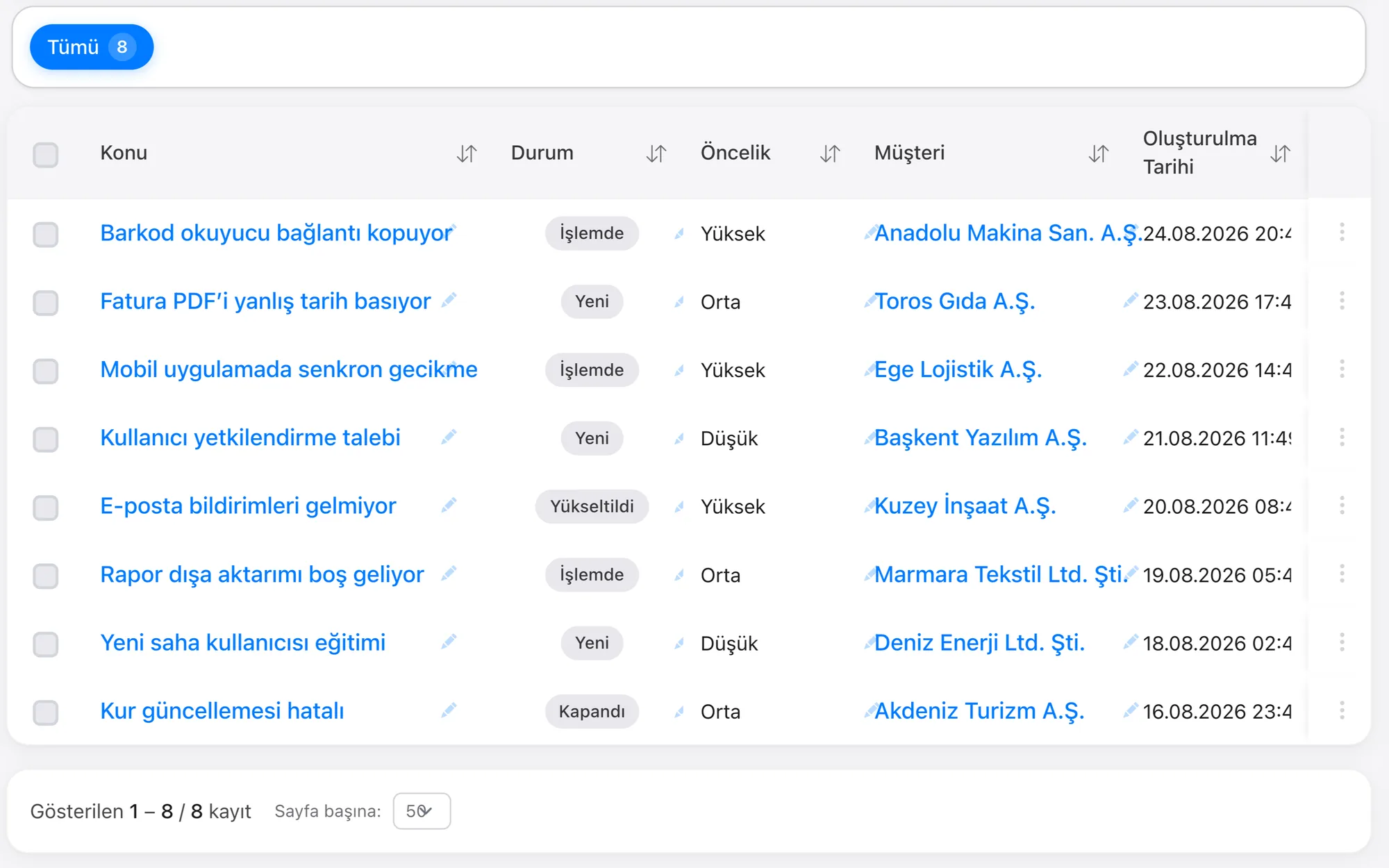
Requests and fault records meet under the same subscriber; class, opening time and outage duration are fields, and quality indicators come from their periodic report.
Electricity Distribution CRM
  • Run new connection, capacity increase, tariff and complaint requests from a single panel and track response times
  • Classify fault notifications by the rule you define, assign them to field crews and monitor resolution time
  • Set up the task plan for meter reading, maintenance and repair crews and measure their performance
  • Keep service quality indicators and outage statistics ready for regulatory reports
Subscriber Request ManagementA request is opened as a record; its type and opening time are among its fields, and the response time is calculated from those dates and appears in the report.
Fault and Outage ManagementA fault record carries a class field; the assignment rule is bound to that field during setup, and the resolution time follows from the record's dates.
Field Operations CoordinationMeter reading, maintenance and repair jobs are tasks assigned to a person; how much work each crew closed is read from the task report.
Regulatory ReportingOutage duration and customer count are fields on the fault record; quality indicators are produced from the periodic report of those fields.

The moment an outage starts, two jobs begin at once: the field crew has to find the fault, and someone has to decide what to tell the hundreds of subscribers reaching the call centre. When those two run in separate places, not a single line about the fault ever lands under the subscriber's record; the record looks closed, while the subscriber still does not know what happened.

Rapitek CRM brings the request and the fault record together under the same subscriber; once the notification has been classified and assigned to the field, the elapsed time accumulates on the record. Because the same data turns into outage statistics and the service quality indicator at the end of the month, regulatory reporting stops being a separately compiled job. We build the connection to SCADA and outage management systems ourselves; there is no out-of-the-box module. If such a connection is needed, it is set up specifically for your project over our REST API, OAuth2, webhooks and import/export, and its scope is defined in writing during the discovery call.

What the plans cover and which items are priced separately are written on the pricing page.

Frequently asked questions

Can subscriber management be done for electricity distribution companies?
Yes. Subscriber records, tariff management and request tracking are held in a structure that does not require keeping a separate table as the number of subscribers grows.
Is there integration with the outage notification system?
We build the connection to SCADA and outage management systems ourselves; there is no out-of-the-box module. The connection is set up specifically for your project over our REST API covering 183 business objects, OAuth2, webhooks and import/export; its scope and cost are shared in writing during the discovery call. Until that connection is built, outage information is entered with an import file or by hand; subscriber requests, fault records, field tasks and outage duration fields are still held in the CRM, and quality indicators are produced from those records.
Can I see an overdue subscriber request in time?
The request's type and opening time are fields on the record; the response time is calculated from those dates, and requests that pass the threshold collect in their own list. The threshold is defined during setup.
Which is the best CRM software for electricity distribution?
When choosing a CRM for the electricity distribution sector, you should look at sector-specific workflows, integration capabilities, customisation options and support quality. You do not set Rapitek CRM up yourself, we do: we configure the fields, stages and reports around your distribution process, we migrate your data, and we give your team training in Turkish. Before building our own platform, our team completed more than 200 enterprise CRM projects in its Salesforce years; we do the setup with that experience.
How much does an electricity distribution CRM system cost?
In electricity distribution, meter reading, maintenance and repair are tasks assigned to a person; the whole field crew is in the system. We keep current plan prices in one place and publish them openly on our pricing page; we do not write figures on this page, so that you never read a different price in two places. The price is set by the number of users and the plan chosen. The scope of setup, data migration and training is not the same in every project; the scope and any setup fee are worked out together during the discovery call and shared in writing. Rapi AI credit and ERP integration are separately priced items.
How does the move to a CRM system work in the electricity distribution sector?
We start with a discovery call: we work out your distribution process together, and which fields and which stages are needed. After that call we give you a date, not a range. We migrate your data, and we give your team training in Turkish. There is no call centre on our support line. Your question is answered by the team that builds and develops the product — this is a choice, not a matter of capacity.
Can mobile CRM be used for electricity distribution?
Yes — the electricity distribution crew in the field can update the meter reading, maintenance and repair tasks assigned to them from a phone. The app is live on both the App Store and Google Play. The web interface works on tablets and phones too. The app does not work offline; if the connection drops while you are filling in a form, what you wrote is kept on the device for 24 hours.
Made with RapitekGO

We would like to use optional cookies to measure your visit. The site works exactly the same if you decline. Cookie policy