
Skip to content

Solar Energy CRM

Selling solar does not end with one meeting; the consumption bill, the roof measurement, the sizing, the bid and the grid application spread over months. In that time prices change, the application waits its turn, and the customer does not remember which bid they last saw.

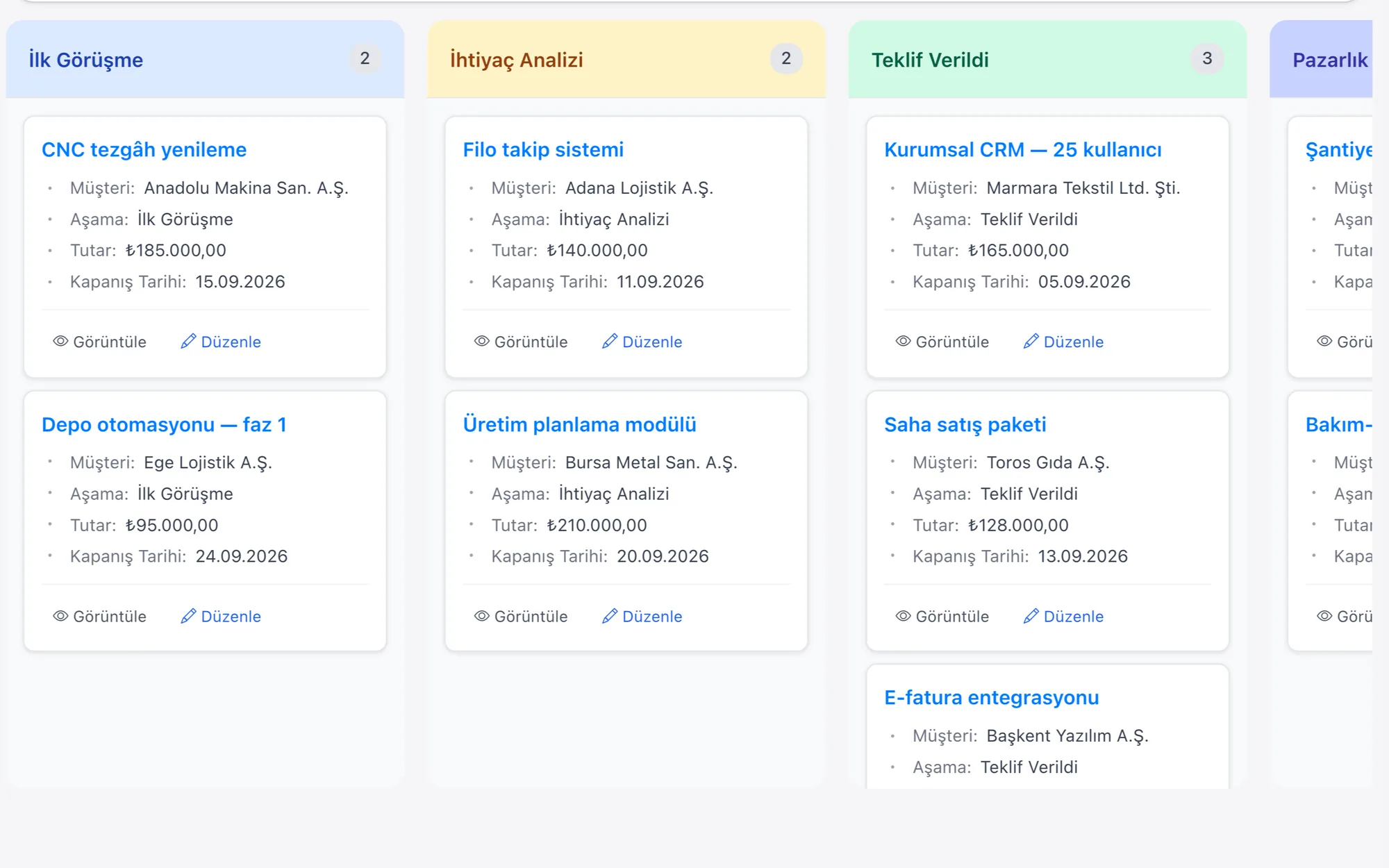
Roof area, consumption data and target installed capacity are fields on the project record; bid revisions are versioned, and a price past its validity date drops off the open list.
Solar Energy CRM
  • Run rooftop and ground-mount projects through separate processes, and keep consumption data and target installed capacity on the opportunity record
  • Version the bid together with its revisions, and stop a price past its validity date from staying on the open list
  • Track connection application and contract dates as fields, and list the files awaiting an answer by date
  • Set up a follow-up task and reminder sequence for projects that have been inactive for a long time
Project OpportunityEvery solar project is an opportunity record; roof area, consumption data and target installed capacity sit in fields on that record.
Bid VersionA bid is a record with a validity date; revisions accumulate as separate versions, and a price whose term has expired drops off the open list.
Application TrackingThe distribution company application is a date field; the application date and the expected answer date are entered on the record, and overdue files drop into a list.
Follow-up SequenceA contact sequence can be defined for a project that has gone quiet; when the number of days you set runs out, that definition supports opening a task for the person responsible and scheduling a message to the customer.

In solar sales, the business you lose is not the business that was turned down, it is the business that was forgotten. The customer sends their electricity bill, the system is sized, a bid goes out; then the connection application is filed and an answer is awaited for weeks. During that wait the panel price and the exchange rate change and the bid goes stale; when the customer calls to ask where things stand, it is not even clear who has the file. On top of that, a bid given for a rooftop is not the same process as a ground-mount project, yet the two get mixed into the same list.

In Rapitek CRM every project is an opportunity record and its stages are set up to fit your process: survey, sizing, bid, application, contract. Consumption data, roof area and target installed capacity sit in fields on the record; bid revisions accumulate as versions and a price past its validity date drops off the open list. The application filed with the distribution company is a date field — it does not connect automatically to the application systems, your team enters the date — but once it is entered, files whose answer is overdue drop into a list according to that date, so no application waits in silence.

The scope of the plans and the separately priced items are written on the pricing page.

Frequently asked questions

How does the CRM keep bid revisions and price validity?
Every bid is a record with its own validity date and revisions accumulate as separate versions; which price went to the customer last and on what date is read from the record, and a bid whose term has expired drops off the open list.
Can I track the applications made to the distribution company?
The application date and the expected answer date are fields on the project record; these dates do not arrive automatically from the distribution company's systems, your team enters them, but once entered, files whose answer is overdue drop into a list and a reminder goes to the person responsible.
Can I run a rooftop project and a ground-mount project through separate processes?
Every solar project is an opportunity record; roof area, consumption data and target installed capacity sit in fields on that record. Because the stages are set up to fit your process, rooftop and ground-mount projects move through separate stage sets and do not get mixed into the same list.
Which is the best CRM software for Solar Energy?
When choosing a CRM for the Solar Energy sector, you should pay attention to sector workflows, integration capabilities, customisation options and support quality. You do not set up Rapitek CRM, we do: we configure the fields, the stages and the reports to fit your solar energy process, we migrate your data, and we give your team training in Turkish. Before building our own platform, our team completed more than 200 enterprise CRM projects during its Salesforce years; we do the setup with that experience.
How much does a Solar Energy CRM system cost?
On the Solar Energy side it is your project team that enters the grid application date onto the record; that team is who uses the system. We keep the current plan prices in one place and publish them openly on our pricing page; we do not put figures on this page so that you never read a different price in two places. The price is set by the number of users and the plan chosen. The scope of setup, data migration and training is not the same on every project; the scope and the setup fee, if any, are worked out together at the discovery meeting and shared in writing. The Rapi artificial intelligence credit and ERP integration are separately priced items.
How are CRM integrations done in the Solar Energy sector?
On the Solar Energy side the distribution company application is a date field; your team enters the application date and the expected answer date. If you use Logo, Netsis, Mikro or SAP, your CRM talks to it — we build the connection ourselves. There is no out-of-the-box module: because the access and field structure on the ERP side differs from one installation to the next, a single button does not work the same way everywhere. The connection is set up specifically for your project over our REST API covering 183 business objects, OAuth2, webhooks and import/export. We work out its scope and cost at the discovery meeting and share them in writing.
How does the move to a CRM system work in the Solar Energy sector?
We start with a discovery meeting: we work out your solar energy process together, and which fields and which stages are needed. After the meeting we give you a date, not a range. We migrate your data ourselves and we give your team training in Turkish. There is no call centre on our support line. Your question is answered by the team that builds and develops the product — this is a choice, not a matter of capacity.
Can mobile CRM be used for Solar Energy?
Yes. Field and branch teams can update the customer record, notes and follow-up tasks from their phone. The app is live on both the App Store and Google Play. The web interface works on tablets and phones as well. The app does not work offline; if the connection drops while you are filling in a form, what you have written is kept on the device for 24 hours.
Made with RapitekGO

We would like to use optional cookies to measure your visit. The site works exactly the same if you decline. Cookie policy