
If you use Claude, your CRM talks to Claude.
This connection runs in production today; setting it up does not require a provider-specific project. Rapi, the assistant inside the product, runs on Anthropic Claude and does not only read the CRM — it writes records too. And with the MCP package you download from the Setup screen, you connect your own Claude to the same CRM with 18 tools.
Why does AI end up bolted on in a CRM?
When AI comes up, two separate expectations get sold with the same sentence on the CRM side. The first is an assistant embedded in the product: one that finds what you ask for, summarises, writes. The second is the assistant the team already uses — a team that works with Claude all day wants to reach the CRM from that same window.
In both cases the mechanism jams at the same point — as we have seen it in our own projects:
- If the assistant only reads, the work is not finished: you read the summary and still open the record yourself, still fill the field in by hand.
- If the assistant is outside the CRM, copy-paste creeps in between; where the record came from is lost, and no trace is left behind.
- When AI is positioned as an add-on, the tool the team actually uses and the tool inside the CRM stay two separate worlds.
- And this question goes unanswered: where does this assistant take the data, who turned it on, can I turn it off when I want to?
This page's job is to answer those four questions one by one: first what it is, then where it stands, then where it does not.
This connection is live today — and it is really two separate things
1. The assistant inside the product: Rapi. Rapi runs on Anthropic Claude and does not only read the CRM — it writes records too. Today it has ten tools; it fetches, creates and updates core records such as leads, contacts, companies and opportunities. Every field it changes on existing records lands in the product's field-level change history; the initial values of a record it creates are not recorded there.
2. Your own Claude: the MCP package. The package you download from the Setup screen — the version live today is v1.11.0 — contains 18 tools and connects your own Claude client to the CRM. The surface this connection rests on is the same one integrators use: a REST API authorised with OAuth2, describe for reading the object schema, composite for multiple operations in a single request, and bulk endpoints.
What we can say about usage, and what we cannot. Rapi runs in production today; the weight of that use, however, is still our own team. That is why on this page you will not find a figure for how many runs it has done, or a sentence saying “our customers connect their own Claude”. What we can state is what the product does; what we cannot measure is who uses it and how much. We wrote up our general approach to integrations with the same openness on the integrations page.
Wednesday 11:15 — a quote is being prepared. With Rapi turned on, this is what changes:
-
1
You ask for the customer by name, and Rapi brings up the record
Company, contact and open opportunity records arrive without searching the list screen. Rapi produces the answer not from the internet, but from the records in your own CRM database.
-
2
The meeting note stays as a record, not as a summary
When you have the note written, Rapi posts it to the relevant record. The assistant's job does not end with producing a summary; the record itself changes, and you do not need to open the screen a second time.
-
3
Missing fields are not opened and filled one by one
You ask for fields such as tax number, industry or owner to be updated; Rapi updates the record. You are the one who says what is wanted — Rapi does not start a job on its own.
-
4
The quote → order step is already built into the product
The record action that turns a quote into an order is built into the product. The chain is not a flow the assistant invented; it is the product's own action.
-
5
Changes to existing records leave a trace
Every field Rapi changes on existing records lands in the field-level change history: when which field moved to which value (for protected fields, only a marker). The initial values of a record Rapi creates are not recorded there. The changes the AI makes stay auditable.
-
6
If the job runs long the assistant stops; it does not carry on by itself
The number of steps that can be taken in a single request is limited — at most eight. Rapi is not an agent running in the background; every job starts with a request you initiate and ends with that request.
The surface you rest on when you connect your own Claude
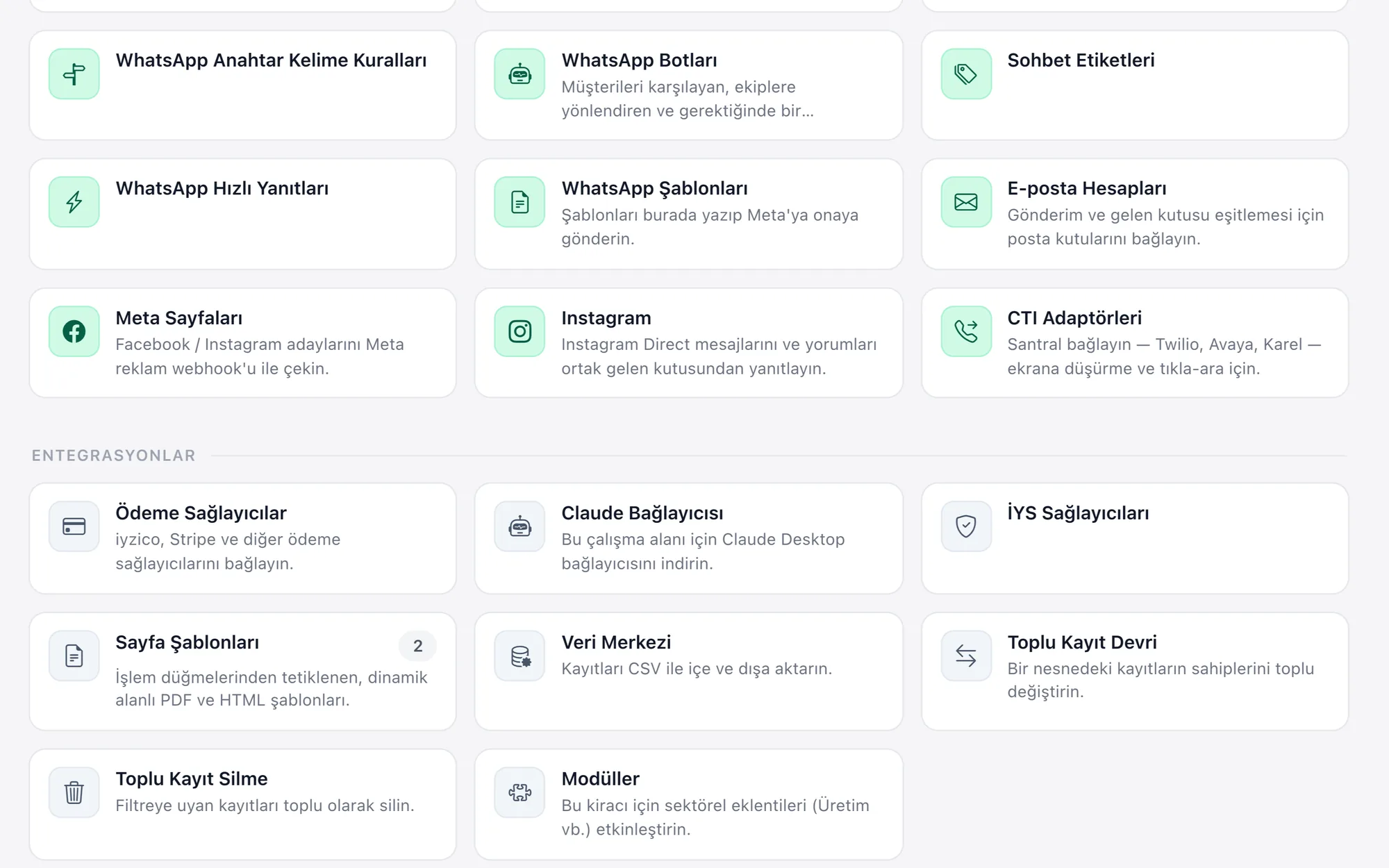
An MCP package with 18 tools
The package is downloaded from the Setup screen and registered with your own Claude client. The version live today is v1.11.0; the package contains 18 tools.
Authorisation with OAuth2
Access is granted with OAuth2; no connection is made by sharing a user password. You can withdraw the authorisation just as you granted it.
183 business objects, each with its own endpoint
The product ships out of the box with 183 business objects, and each one is published in the REST API with its own data and schema endpoint — you can read the field structure from outside with describe.
Reading the schema with describe
The object schema is read from the API; the connecting code does not have to track the field list by hand. When the schema changes, what is read changes with it.
composite and bulk endpoints
More than one operation can be sent in a single request — composite carries 25 sub-requests; bulk endpoints work on up to 200 records in a single call.
The change history covers the assistant too
Changes made through the assistant to existing records also land in the field-level change history; when which field moved to which value is visible (for protected fields, only a marker). The initial values of a record created through the assistant are not recorded there; the creator and creation time are set by the system and cannot be changed from the user screens, data import or the API.
Rapi, or your own Claude?
| Topic | Rapi — the assistant inside the product | The MCP package — your own Claude |
|---|---|---|
| Where it runs | Inside the CRM: in the mobile app, alongside the record screens | In your own Claude client; it connects to the CRM without disturbing the way you already work |
| Number of tools | 10 tools | 18 tools |
| How it is enabled | Enabled per tenant, and off by default | Downloaded from the Setup screen; access is authorised with OAuth2 |
| Does it write records | Yes — it reads and writes; it creates and updates core records such as leads, contacts, companies and opportunities | The authorisation you grant determines the scope of access; you decide how much of it to open |
| What its limit is | At most eight steps in a single request; it does not run by itself in the background | The package is a Claude connector; we do not say it has been tested with any other client |
| Where the request goes | While the assistant is on, to Anthropic's service in the United States | To Anthropic through your own Claude account; the contract on that side is between you and Anthropic |
What we have verified
How is the Claude side switched on?
-
1
The decision is yours
The AI assistant is off by default and is enabled per tenant. As long as it is not enabled, no AI request involving your CRM data is made.
-
2
We set the framework for the transfer in writing
When the assistant is enabled, requests go to Anthropic's service in the US. This is a second cross-border transfer on top of the hosting in the EU. Anthropic is named in the sub-processor list on our security page. We establish the basis for the transfer together during the contract process.
-
3
Installing the package for your own Claude
The MCP package is downloaded from the Setup screen, registered with your Claude client, and access is authorised with OAuth2. You decide who connects and with what scope.
-
4
Auditing and turning it back off
Updates made through the assistant to existing records are tracked in the change history; the initial values of newly created records are not recorded there. If you change your mind, the assistant is turned off from the same place; the rest of the CRM carries on working exactly as it did.
Our limits: what we do not promise on this page
AI is the subject where overstating is easiest. We name the things we do not promise.
- We do not say “autonomous agent”. Rapi does not run by itself in the background: every job starts with a request you initiate, and the number of steps that can be taken in a single request is limited — at most eight. We are not selling a system that works through the night and puts finished work in front of you in the morning.
- We do not publish a usage figure. Rapi runs in production today, but the weight of that use is still our own team. We have no measurement that would let us say “our customers connect their own Claude to the CRM”; and because we do not have it, we do not say it.
- The MCP package is a Claude connector. We cannot say we have tested the package with any other AI client. If you want to connect another assistant, the route is the REST API and OAuth2; that is a separate piece of work whose scope is set in discovery.
- The assistant does not change the product's general limits. We do not promise stock synchronisation, an order-invoice-collection chain that flows on its own, or production automation; turning the assistant on does not change that. How we scope connections to ERP and accounting systems is on the integrations page.
Data location — and the second transfer here. Your data sits in the European Union: the database in Helsinki (Finland), the files and media you upload in Frankfurt (Germany), the database backups in Falkenstein (Germany). We have no component in Türkiye, and we have no such feature as region selection. The AI assistant adds a second cross-border transfer on top of this: while the assistant is on, requests go to Anthropic's service in the United States. That is precisely why the assistant is off by default and is enabled per tenant. Seen from Türkiye, both transfers fall within the scope of Article 9 of Law No. 6698; we establish the basis for them together during the contract process and state in writing which component sits in which country. We named Anthropic, together with the country it is in and the condition under which it comes into play, in the sub-processor list on our security page.
Certification: we do not have an ISO 27001 or SOC 2 certificate, and we will not claim one until we do. We fill in your enterprise security assessment forms and describe the architecture in writing.
Plan prices are out in the open; scope comes out in discovery
The Claude connection runs in the product today; Rapi AI credit, on the other hand, is a separately priced item. We publish plan prices and the separately priced items on a single page, with the figures.
Three plans, a scope table and the separately priced items on a single page.
Frequently asked questions about the Claude integration
Does AI really work in Rapitek CRM?
Which AI provider does Rapi run on?
Does Rapi only read, or does it write records too?
Can I connect my own Claude account to the CRM?
What is the MCP package?
Does the package work with ChatGPT or Gemini as well?
Is the AI assistant on by default?
Does our data go to Anthropic?
How do we audit the changes the assistant makes?
Does Rapi work autonomously — does it do work by itself overnight?
Where is our data held?
Can we see it before we buy?
Let's look at the Claude side with your own data, in 30 minutes
In the demo, let us show you Rapi writing records and how the MCP package connects to your own Claude, using your scenario; and let's talk through the decision on whether to enable the assistant together.
The assistant is off by default; the decision to enable it and the written framework for the transfer are handled as part of setup.
