
Facility Management CRM
When the service-charge accrual sits in a spreadsheet, the resident's fault report in a messaging group and the maintenance appointment in the manager's diary, both who still owes money and which job was never done only surface at the end of the month.
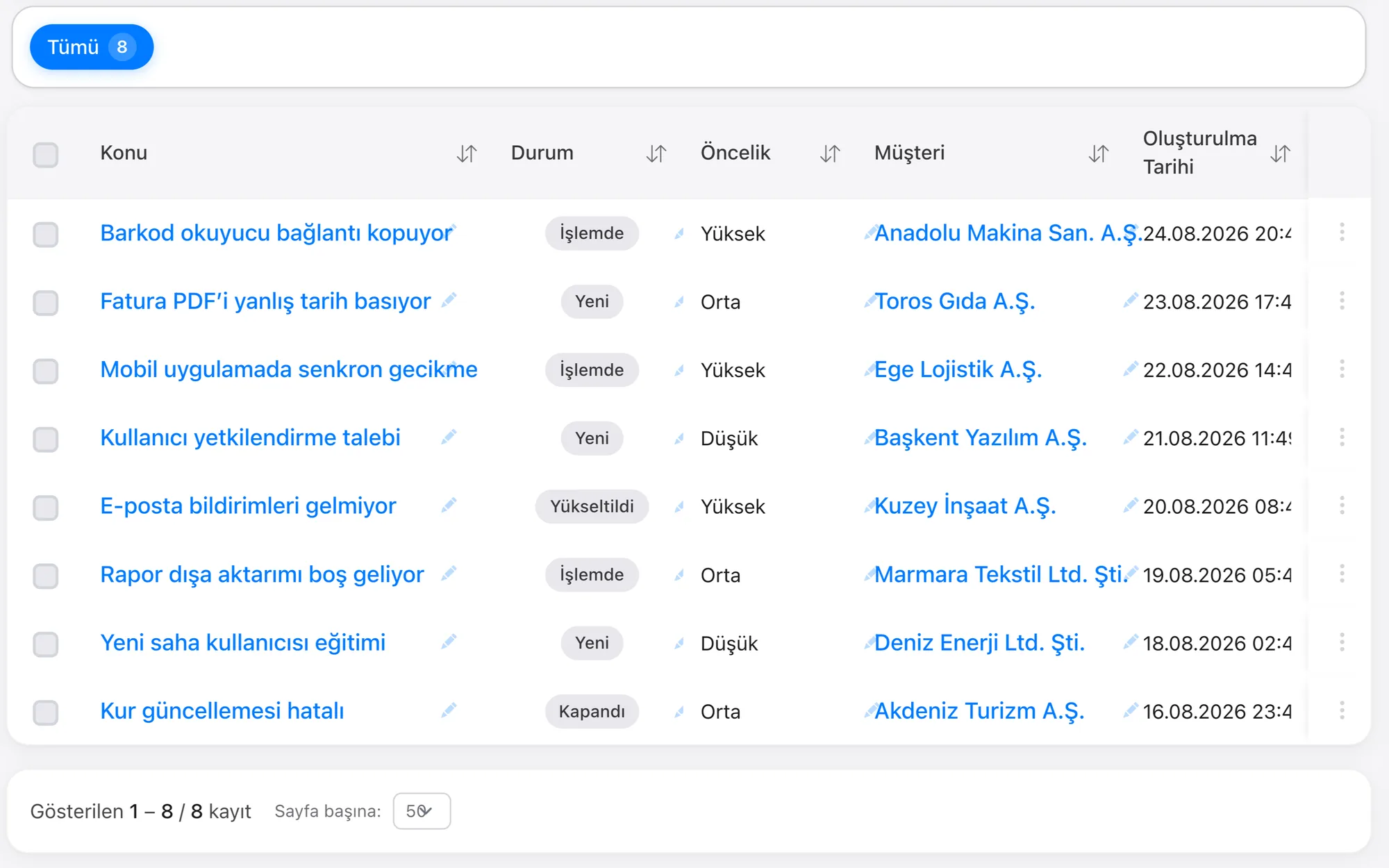
A unit is a record; service-charge lines sit under it period by period, an overdue line drops into a list, and the resident's fault report links to that same unit.
What we set up, and how
- Create service-charge accruals unit by unit; let overdue lines drop into a list and tie the late-payment reminder to that list with a rule
- Receive residents' faults, complaints and suggestions digitally and follow the resolution through until it is closed
- Set up the periodic maintenance calendar and manage technical staff assignments job by job
- Produce monthly and annual income-expense reports and share them transparently with residents
| Service Charge Management | A unit is a record; service-charge lines are kept under it period by period, and an overdue line drops into a list. |
|---|---|
| Resident Request Management | A request is opened as a record and linked to the unit; it stays in the list until it is closed, the resolution time comes out of the record dates, and earlier requests from the same unit are listed under the card. |
| Maintenance and Repair Planning | Periodic maintenance is a recurring task tied to a date field; the technical staff assignment sits on that same task. |
| Income and Expense Reporting | Because income and expense lines sit inside the records, monthly and annual reports are taken by selecting a period, and the same output is shared with residents. |
A facility manager's month runs on two lists: who has not paid, and what has not been done. When the two are kept in separate places, an unnamed transfer landing on the bank statement cannot be traced to a unit, and a fault the same resident reports for the second time does not sit on top of the first. At the general assembly, the paperwork for both lists is asked for.
In Rapitek CRM, payment transactions are matched to unit records: transactions are entered by hand or through an import, and if a connection to the bank side is wanted, we build that too; there is no out-of-the-box module, the connection is built for the specific project over the API. An overdue service-charge line drops into a list and you tie to a rule when the reminder goes out; reports and maintenance jobs accumulate under the same unit. If more than one residential complex or block is managed, all of them are followed from a single panel, and reporting comes out separately for each.
The scope of the plans and the separately priced items are set out on the pricing page.
