
IT Services CRM
The same engineer's hours go both to the ongoing project and to the support request that cuts in; the maintenance contract that needs renewing, meanwhile, is only noticed when the customer brings it up.
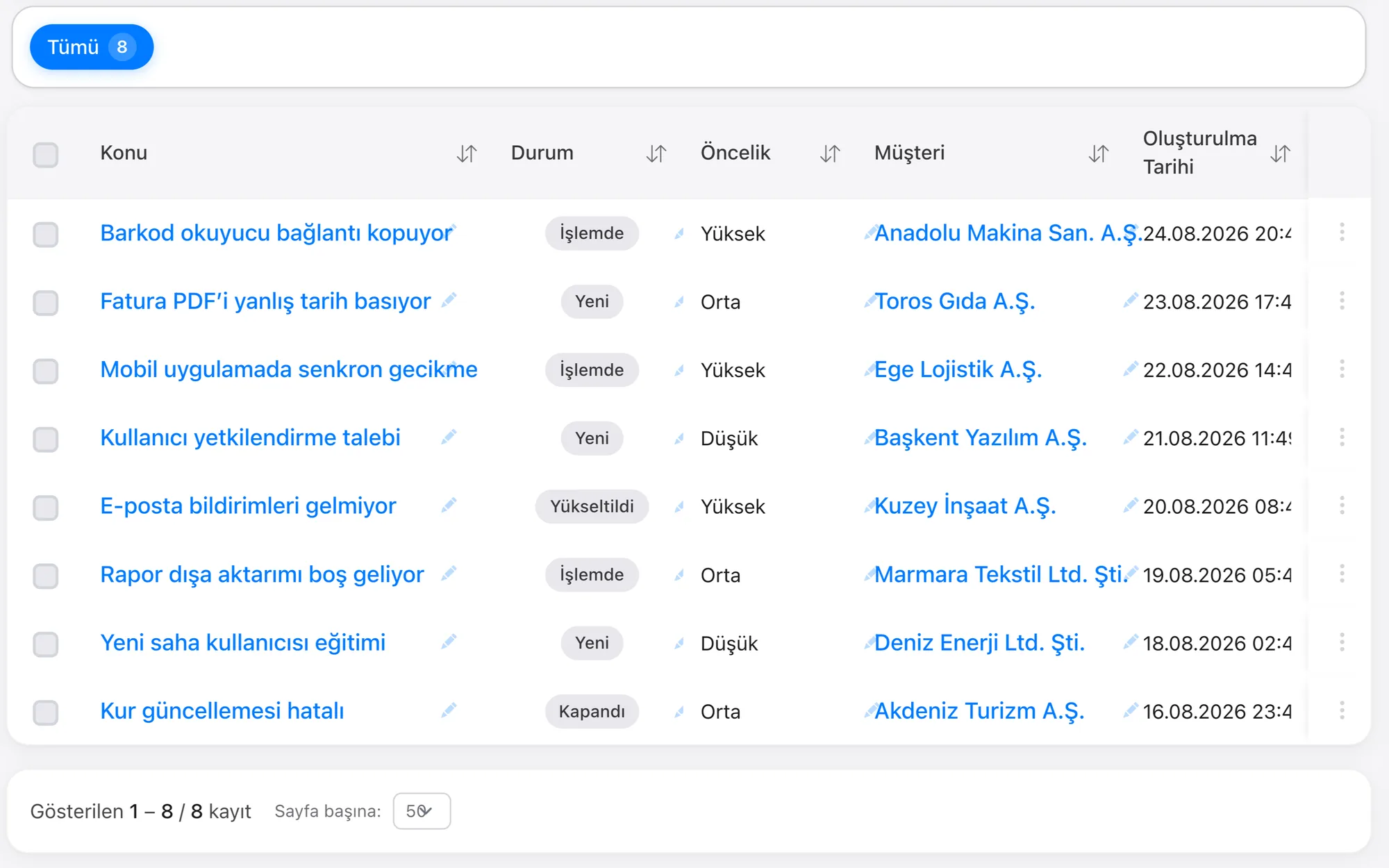
Every incoming support request is a record; its category, priority and the promised response time are its fields. The support hours the customer bought come down with every request closed.
What we set up, and how
- Keep project stages, team assignments and the hours spent on the project in one place
- Sort incoming support requests by category and priority and track them against the response time you promised
- Follow maintenance contract and licence renewal dates together with the revenue forecast
- Have the solution note written onto the request so that later requests opened with the same type are read from those records
- Let the whole team reply over a single business number, with conversations assigned according to the rule you define and visible to the manager
| Project and Resource Management | A project is a record; the stage and team assignment sit in its fields and the hours spent sit in the lines beneath it; which job an engineer booked how many hours to is read from those lines. |
|---|---|
| Support Request System | Every incoming support request is a record; its category, its priority and the response time target you promised your customer are fields on that record; requests past their target time collect in a single list by date and drop to the person responsible as a task. |
| Contract and Licence Tracking | The maintenance contract and the licence are records attached to the customer account; the renewal date and the amount are in fields, the ones with a date approaching drop into a list, and the revenue forecast comes out of that list. |
| Solution Note | The solution note is written onto the request and later requests opened with the same fault type are read from those records; technical notes specific to a customer sit on that customer's account record. |
| Support Hour Package Counter | The support hours the customer bought are a field on the contract record; the time booked to each closed request comes off that field, and a renewal task is opened for the person responsible before the package runs out. |
In IT services a fault usually arrives not through a corporate channel but from the personal phone of the engineer the customer knows. The solution given in that message is written down nowhere; six months later, when the same problem turns up at another customer, it is researched from scratch. And when the engineer leaves, that customer's entire history goes with them.
Rapitek CRM moves this traffic onto a single business number: in the team inbox the messages are visible to everyone, the conversation is assigned to its owner according to the rule you define, and the correspondence stays on the customer card even when staff change. Because the solution note is written onto the request, later requests opened with the same fault type are read from those records; and since contract and licence items sit on the same record, the renewal period shows up inside the sales plan.
