
Skip to content

Interior Design CRM

In interior design work, disputes come not from the price but from which version of the design was approved. Fabric, colour and lighting choices change several times over the course of the meetings; by installation day everyone has a different version in mind.

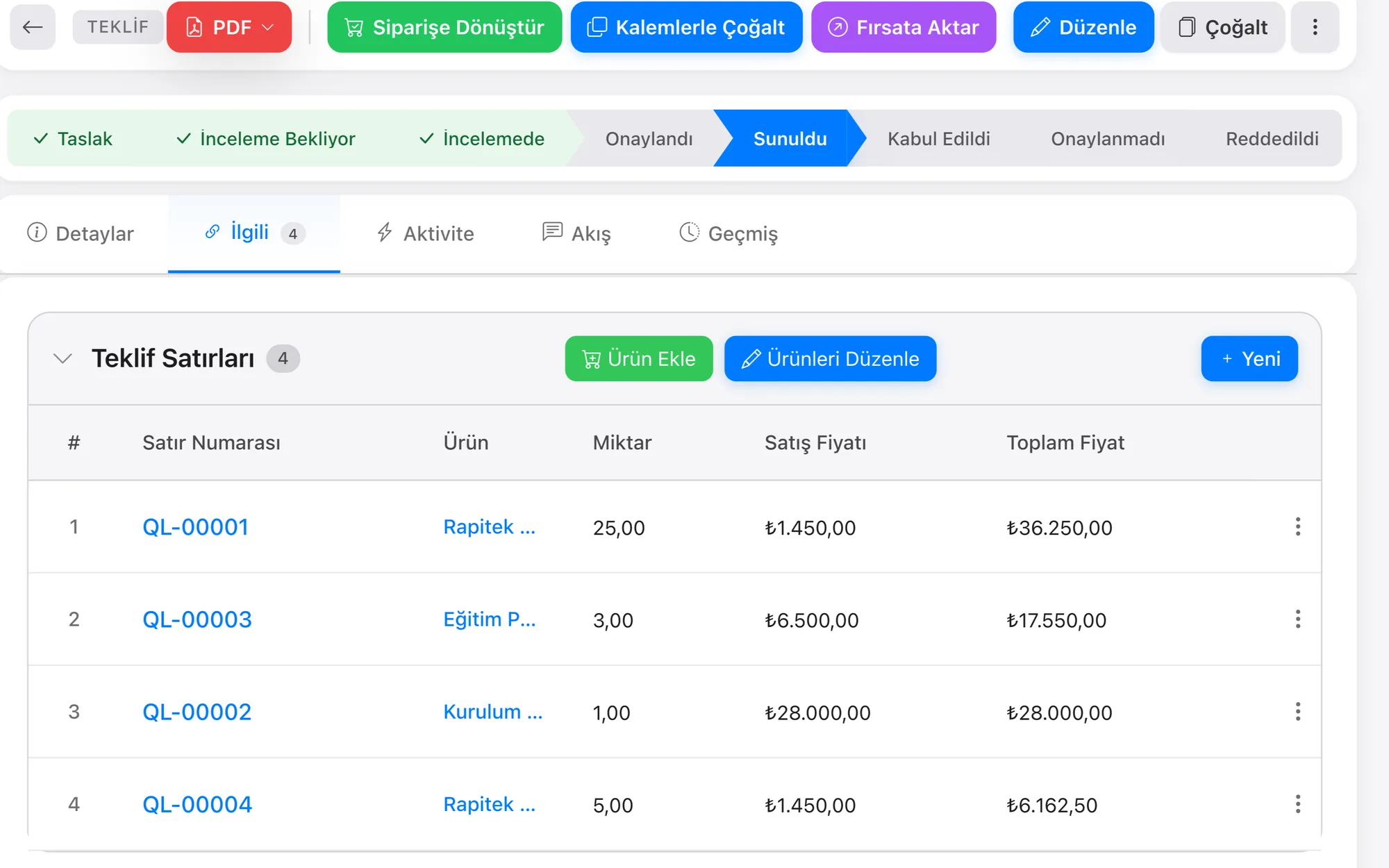
Every revision is a dated record under the project record; the approved version shows in the current-version field. In Rapitek CRM, an item whose supplier delivery date slips drops into a list.
Interior Design CRM
  • Keep concept revisions version by version under the project record; take the customer's approval on the signature screen in the mobile app and mark the signed version as current
  • Attach the chosen products to the record item by item and track the supplier delivery date in the item's field
  • Plan the installation and delivery appointment as a task and send the customer's reminder from the same record
  • Report the site visit from the mobile app and add the photos of the space and the measurements to the project
Concept VersionsEvery revision is a dated record under the project record; when the customer approves on the signature screen in the mobile app, that version shows in the current-version field, and the next change opens a new version.
Product Selection ListThe chosen products are items attached to the project; brand, code and quantity sit in fields, and a changed selection is added as a new line without deleting the old item.
Supply TrackingThe supplier delivery date is a field on the item; items whose date has passed drop into a list, and the task to inform the customer is opened from there.
Curtain and Accessory InstallationThe day the curtains, lighting and furniture are fitted is a task attached to the project record; the team, address and time are in fields, the item list under the task carries the products to be fitted that day, and the reminder sent to the customer is generated from that date.

An interior job does not close with a single quote: a site visit is made, a concept is presented, the customer asks for two or three rounds of revisions, the chosen fabric turns out to be unavailable at the supplier and an alternative is discussed. Most of these rounds run over messaging; which image was approved and which product code stayed in the final version gets lost inside the correspondence. A single different product turning up at installation holds up both the work and the payment.

In Rapitek CRM the project is a record; every revision sits under that record with its own date, the customer gives approval on the signature screen in the mobile app, and the signed version is marked as the current version; there is no arguing later about which one applies. The chosen products are attached to the record item by item, the supplier delivery date sits in a field on the item, and a product whose date slips drops into a list. Installation is a task; the team and the appointment time are in fields, and the reminder sent to the customer goes out from the same record.

The scope of the plans and the separately priced items are written on the pricing page.

Frequently asked questions

How do we prove which design the customer approved?
Every revision is stored under the project record with its own date; the customer gives approval on the signature screen in the mobile app and the signed version is marked on the record as the current version, while later changes open a new version.
Do we hear about it if a chosen product is delayed at the supplier?
Every product is an item attached to the project and the supplier delivery date sits in a field on the item; when the date passes, the item drops into a list, and the task to inform the customer and the alternative product line are opened from the same record.
Where does the team see which products are to be fitted on installation day?
Installation day is a task attached to the project record; the team, address and time are in fields and the item list under the task carries the products to be fitted that day. The reminder sent to the customer is also generated from that date.
Which is the best CRM software for interior design?
When choosing a CRM for the interior design sector, you should look at sector workflows, integration capabilities, customisation options and support quality. You do not set Rapitek CRM up yourself, we set it up: we configure the fields, the stages and the reports around your process in interior design, we migrate your data ourselves, and we train your team ourselves in Turkish. Before building our own platform, our team completed more than 200 enterprise CRM projects in its Salesforce years; we do the setup with that experience.
How much does an interior design CRM system cost?
In interior design the person who goes out on the site visit writes the measurements and the photos into the project from the mobile app, so the field side is a user of the system too. We keep current plan prices in one place and publish them openly on our pricing page; we do not put figures on this page, so that you never read two different prices in two places. The price is set by the number of users and the plan chosen. The scope of setup, data migration and training is not the same in every project; the scope and the setup fee, if any, are worked out together in the discovery call and shared in writing. Rapi artificial intelligence credit and ERP integration are separately priced items.
How are CRM integrations done in the interior design sector?
If you use Logo, Netsis, Mikro or SAP, your CRM talks to it - we build the connection ourselves. There is no out-of-the-box module: because access and field structure on the ERP side differ from installation to installation, a single button does not work the same way everywhere. The connection is built specific to the project over our REST API covering 183 business objects, OAuth2, webhooks and import/export. We work out the scope and the fee in the discovery call and share them in writing.
How does moving to a CRM system work in the interior design sector?
We start with a discovery call: we work out your process in the interior design sector together, which fields and which stages are needed. After the call we give you a date, not a range. We migrate your data ourselves, and we train your team ourselves in Turkish. There is no call centre on our support line. Your question is answered by the team that builds and develops the product - this is a choice, not a matter of capacity.
Can mobile CRM be used for interior design?
In interior design the site visit is reported from the mobile app; photos of the space and measurements are added to the project. The app is live on both the App Store and Google Play. The web interface also works on tablet and phone. The app does not work offline; if the connection drops while you are filling in a form, what you wrote is kept on the device for 24 hours.
Made with RapitekGO

We would like to use optional cookies to measure your visit. The site works exactly the same if you decline. Cookie policy