
Skip to content

Plumbing CRM

In plumbing the day is made of two jobs: a building job planned weeks ago and a water leak call that came in ten minutes ago. Because the two share the same plumbers, every time an emergency call comes in the planned job is quietly pushed back, and the customer is the first to notice.

The site visit turns into a quote record; materials and labour are separate line items. An emergency call is a case record with a priority field and sits on the same day list as planned jobs.
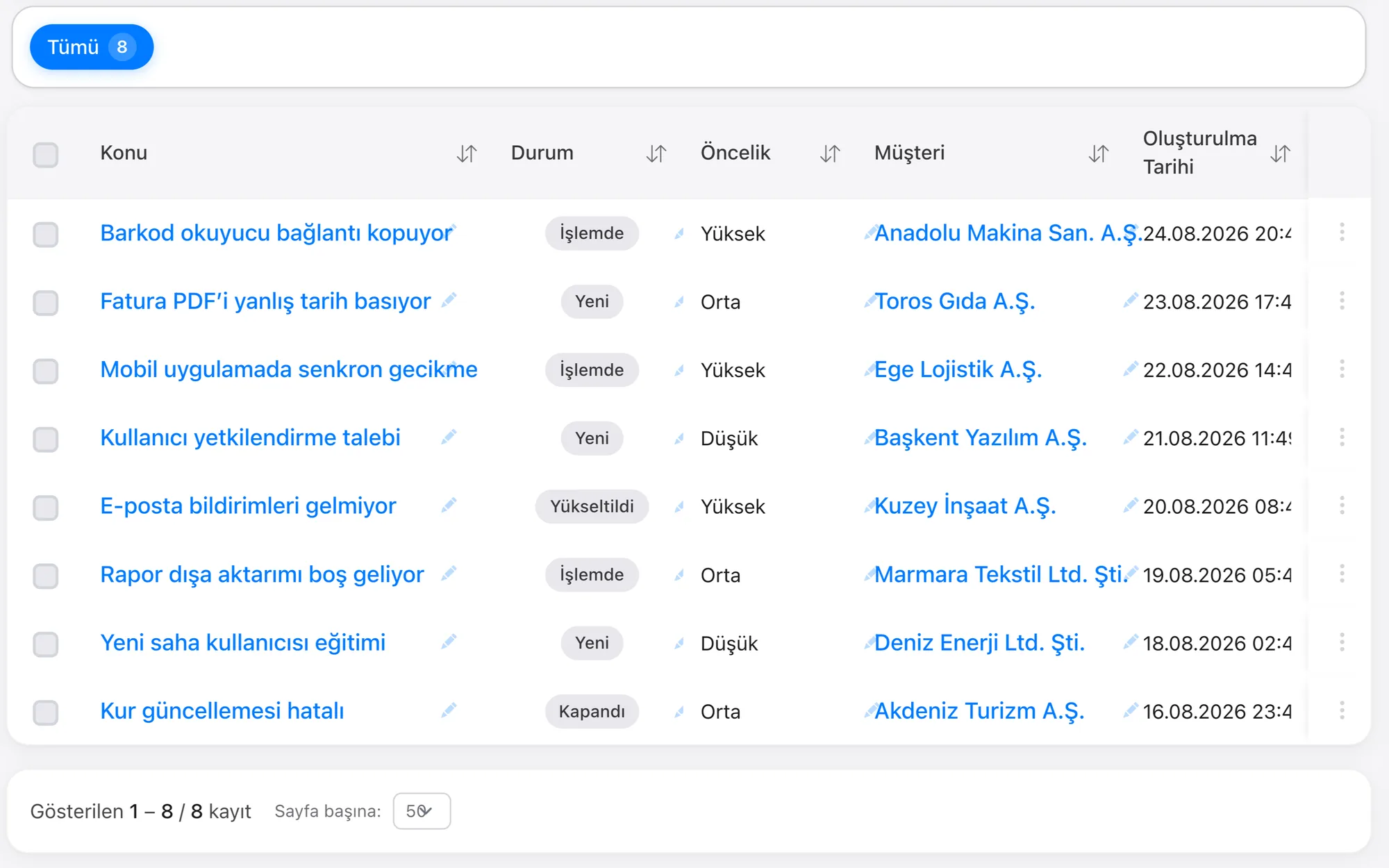
Plumbing CRM
  • Prepare the quote that comes out of the site visit with separate material and labour line items, and take the customer's approval from the signature screen in the mobile app
  • Drop emergency calls to a plumber according to priority, using the queue and the assignment rules defined during setup, and see them on one day list together with the planned jobs
  • Build up the plumbing history of every address on the record and attach a call that comes back within the warranty period to the first job
  • Keep the management of blocks of flats and housing estates on an account record and follow the flat-by-flat jobs and collections under the same account
Site Visit and QuoteThe site visit turns into a quote record; materials and labour are separate line items, and the customer's approval is taken from the signature screen in the mobile app and stays on the record.
Emergency CallThe call is a case record; it has a priority field, the queue and the assignment rules defined during setup drop it to a plumber, and calls that have not been closed stay in a single list.
Address HistoryThe work carried out accumulates under the address record; the warranty end date is a field, and a new call from the same address is attached to the first job.
Managing Agent AccountThe management of a block of flats or a housing estate is an account record; the individual flats are records attached to it, and the work and the collections gather under the same account.

In plumbing the price is given verbally at the site visit: the plumber looks at the job on site, says a figure, and when the work is done what the materials and the labour came to is argued over. Emergency calls come in on the same day as well; because a water leak or a blockage cannot wait, the plumber is pulled off the planned job, and nobody tells the customer of that planned job. The most expensive of all is a fault that recurs while still under warranty: someone goes to the same address a second time, tries to remember what was done the first time, and the cost of that trip is not written anywhere.

In Rapitek CRM the site visit turns into a quote record; materials and labour are written as separate line items, the customer's approval is taken from the signature screen in the mobile app, and the figure discussed at the end of the job stays on the record. An incoming call is a case record, and the queue and the assignment rules defined during setup drop it to a plumber according to its priority; because planned work orders and emergency calls appear on the same day list, the job that has been pushed back becomes visible and the notification to its customer is sent from that same record. Since the work carried out accumulates under the address record, a second call from the same address within the warranty period is attached to the first job, and which job has come back can be reported.

What the plans cover and which items are priced separately are set out on the pricing page.

Frequently asked questions

When an emergency call comes in, can I see how the planned jobs are affected?
Yes. The call is a case record with a priority field, and the queue rules drop it to a plumber; because the planned work orders sit on the same day list, which job has been pushed back is visible in the list and the notification to that customer is sent from the same record.
How do I prevent an argument between the price said at the site visit and the amount at the end of the job?
The site visit turns into a quote record; materials and labour are written as separate line items and the customer's approval is taken on site, from the signature screen in the mobile app. If the scope changes during the job, the new line item is added to the same record and approved again, so which amount rests on what can be read afterwards.
If a call comes from the same address again within the warranty, can I attach it to the first job?
Yes. The work carried out accumulates under the address record and the warranty end date is a field; a new call from the same address is attached to the first job, and which job has come back is read from the report on that link.
Which is the best CRM software for plumbing?
When choosing a CRM for the plumbing sector you should look at sector-specific workflows, integration capabilities, customisation options and the quality of support. You do not set Rapitek CRM up yourself, we set it up: we configure the fields, the stages and the reports around your plumbing process, we migrate your data, and we train your team in Turkish. Before building our own platform our team completed more than 200 enterprise CRM projects in its Salesforce years; we carry out the setup with that experience.
How much does a Plumbing CRM system cost?
In plumbing an emergency call reaches the plumber through assignment rules, so the plumbers who share the planned work and the calls are defined in the system. We keep current plan prices in a single place and publish them openly on our pricing page; we do not put figures on this page, so that you never read two different prices in two places. The price is set by the number of users and the plan chosen. The scope of setup, data migration and training is not the same in every project; the scope and the setup fee, if any, are worked out together in the discovery call and shared in writing. The Rapi artificial intelligence credit and the ERP integration are separately priced items.
How are CRM integrations done in the plumbing sector?
If you use Logo, Netsis, Mikro or SAP, your CRM talks to it — we build the connection. There is no out-of-the-box module: because the access rights and the field structure on the ERP side change from one installation to the next, a single button does not work the same way everywhere. The connection is built specifically for the project over our REST API covering 183 business objects, OAuth2, webhooks and import/export. We work out the scope and the fee in the discovery call and share them in writing.
How does the move to a CRM system work in the plumbing sector?
We start with a discovery call: together we work out your plumbing process and which fields and which stages are needed. After the call we give you a date, not a range. We migrate your data, and we train your team in Turkish. There is no call centre on our support line. Your question is answered by the team that built and develops the product — this is a choice, not a matter of capacity.
Can a mobile CRM be used for plumbing?
In plumbing the customer's approval of the quote that comes out of the site visit is taken from the signature screen in the mobile app and stays on the record. The app is live on both the App Store and Google Play. The web interface works on tablets and phones as well. The app does not work offline; if the connection drops while you are filling in a form, what you have written is kept on the device for 24 hours.
Made with RapitekGO

We would like to use optional cookies to measure your visit. The site works exactly the same if you decline. Cookie policy