
Skip to content

Agriculture CRM

As an agricultural business grows, the work stops being the work of a single field: on one side are the growers you sign contracts with, on the other the wholesale market, the retail chain, the industrial buyer and the exporter. When the buying side and the selling side are kept in separate spreadsheets, what will be in hand mid-season and what has been promised to whom cannot be seen together.

Contract growers and buyers are both account records; the crop, quantity and delivery period committed sit in attached rows, and purchase and sale meet in one period report.
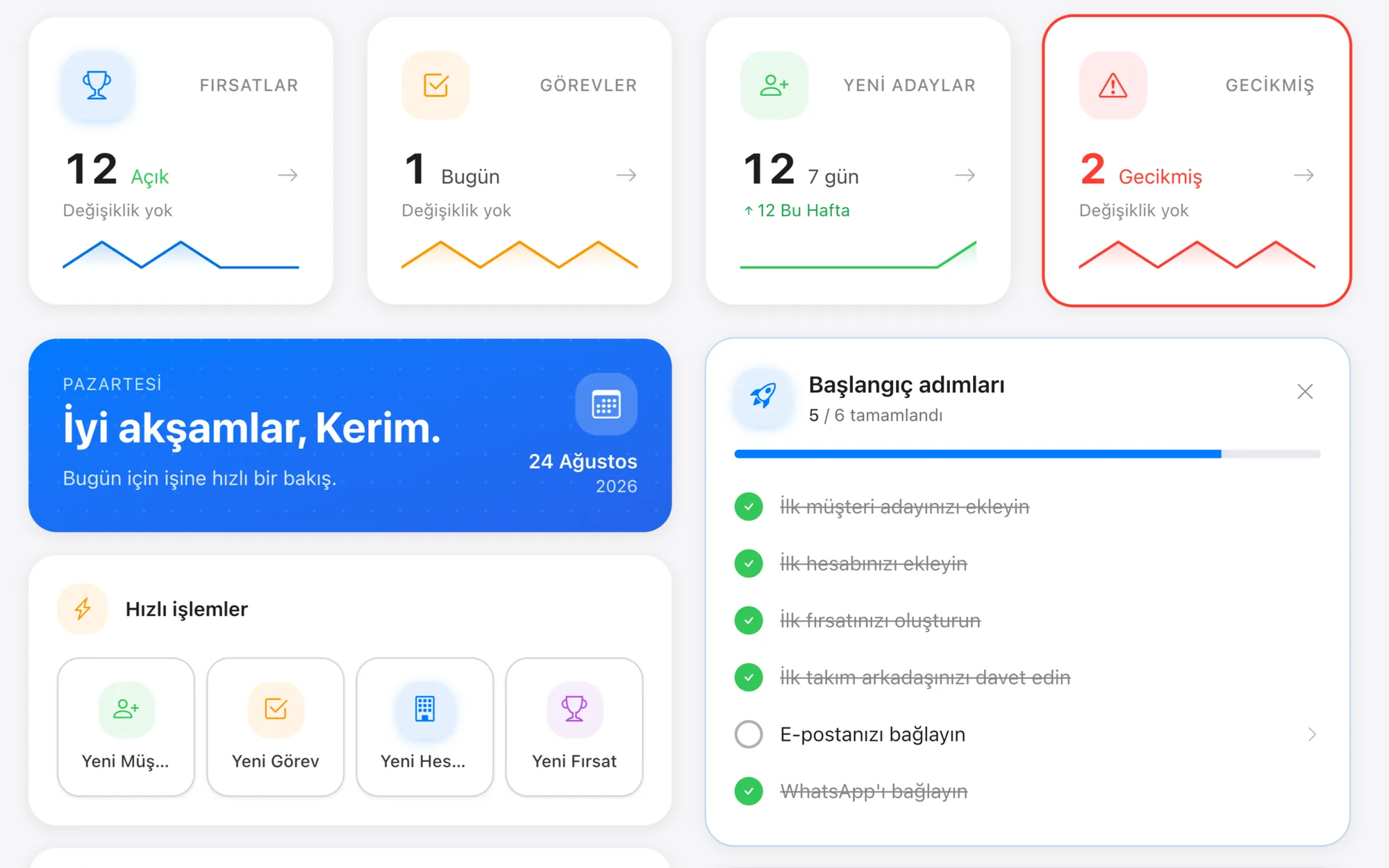
Agriculture CRM
  • Keep contract growers in an account record and write the crop planted, the quantity committed and the advance given into fields
  • Manage the wholesale market, retail, industrial and export channels in separate accounts and apply each channel's own price list from its record
  • Compare purchase and sale commitments in the same list by delivery period and see the shortfall before the period starts
  • Attach the production unit to the record, report which channel the produce from which region went to, and separate permissions by that field as well
Grower NetworkA contract grower is an account record; the crop planted, the committed quantity and the advance given sit in its fields, and deliveries accumulate under the card.
Channel AccountThe wholesale market broker, the retail chain, the industrial buyer and the exporter are separate account records; each channel's price list is attached to its own account.
Period CommitmentThe delivery period is a date field on the record; purchase and sale commitments are listed with the same period filter and compared in a single report.
Production UnitThe facility, the region or the farm is a field on the record; which channel the produce from which unit went to is read from the report on that field.

In agriculture, as the scale grows the problem stops being the problem of a single production unit. On one side there is the contract grower network: who planted what, how much they committed to deliver, whether they took an advance. On the other side there are the channels: the wholesale market broker, the retail chain, the industrial buyer and the exporter, each wanting a different quantity and a different delivery period. When these two sides are kept in separate spreadsheets, the shortfall as the period approaches only comes out on the delivery day.

In Rapitek CRM both the grower and the buyer are account records; the crop, the quantity and the delivery period committed sit in records attached to those accounts, and because they are listed with the same period filter, purchase and sale are compared side by side. Because the production unit is a field on the record, which channel the produce from which facility or region went to is read in the report, and user permissions are also set up around that field. Since every channel's price list is attached to its own account, the price given to the retail chain and the price given to the wholesale market broker for the same product do not get mixed up.

What the plans cover and which items are priced separately are written on the pricing page.

Frequently asked questions

Can I see the quantity coming from a contract grower and the promise given to a buyer in the same place?
Yes. Both the grower and the buyer are account records, and the commitment is a record attached to those accounts; because the delivery period is a date field, purchase and sale commitments listed with the same period filter are compared in a single report.
How do I separate permissions in a business with more than one production unit and more than one sales channel?
The production unit is a field on the record and user permissions are set up around that field; the regional manager sees the records of their own unit, head office sees them all in a single list. Because channel price lists are also attached to accounts, every team works with the price of its own channel.
Can I see the advance given to a grower and the quantity they delivered on the same card?
Yes. A contract grower is an account record; the crop planted, the committed quantity and the advance given are its fields. Deliveries accumulate row by row under that card, and the remaining commitment is read from the same place.
Which is the best CRM software for agriculture?
When choosing a CRM for the agriculture sector you should look at sector workflows, integration capabilities, customisation options and support quality. You do not set up Rapitek CRM, we do: we configure the fields, the stages and the reports around your agricultural process, we migrate your data, and we give your team training in Turkish. Before building our own platform our team completed more than 200 enterprise CRM projects during its Salesforce years; we do the setup with that experience.
How much does an agriculture CRM system cost?
In agriculture, because the production unit is attached to the record and permissions are separated by that field, users are defined unit by unit. We keep current plan prices in a single place and publish them openly on our pricing page; we do not put figures on this page, so that you never read a different price in two places. The price is determined by the number of users and the plan selected. The scope of setup, data migration and training is not the same in every project; the scope and the setup fee, if any, are worked out together in the discovery call and shared in writing. Rapi artificial intelligence credit and ERP integration are separately priced items.
How are CRM integrations done in the agriculture sector?
If you use Logo, Netsis, Mikro or SAP, your CRM talks to it — we build the connection ourselves. There is no out-of-the-box module: because access and field structure on the ERP side change from installation to installation, a single button does not work the same way everywhere. The connection is built specifically for the project over our REST API covering 183 business objects, OAuth2, webhooks and import/export. We work out the scope and the cost in the discovery call and share them in writing.
How does the transition to a CRM system work in the agriculture sector?
We start with a discovery call: we work out together your agricultural process, which fields and which stages are needed. After the call we give you a date, not a range. We migrate your data ourselves and we give your team training in Turkish. There is no call centre on our support line. Your question is answered by the team that builds and develops the product — this is a choice, not a matter of capacity.
Can mobile CRM be used for agriculture?
Yes. The field and branch team can update the customer card, the note and the follow-up task from a phone. The app is published on both the App Store and Google Play. The web interface also works on tablets and phones. The app does not work offline; if the connection drops while you are filling in a form, what you have written is kept on the device for 24 hours.
Made with RapitekGO

We would like to use optional cookies to measure your visit. The site works exactly the same if you decline. Cookie policy