
Skip to content

Government CRM

When the same citizen applies by letter, by phone and through the web form, three separate cases are opened inside the institution and all three move through different units. Which one was answered only comes to light when the applicant asks a second time.

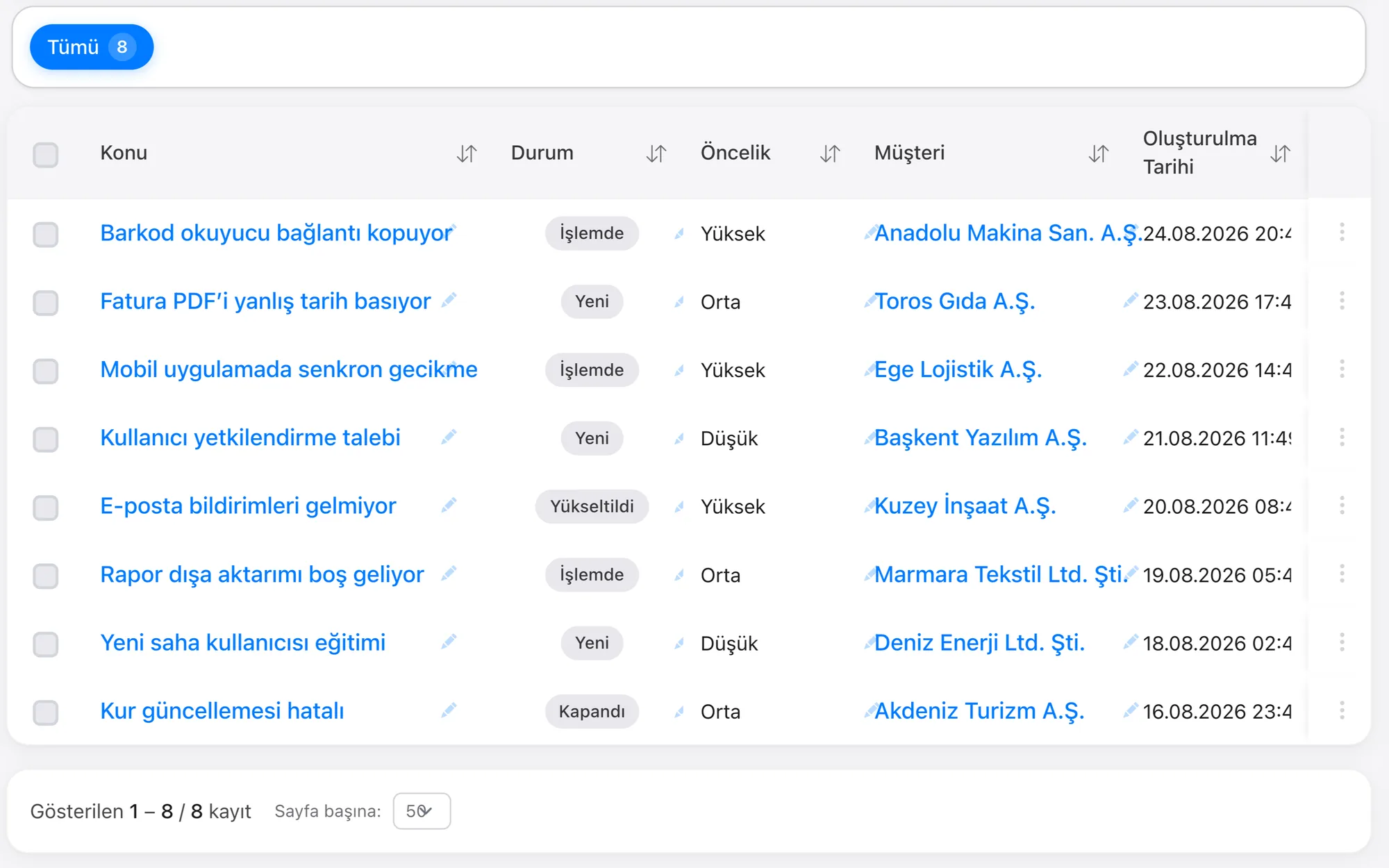
An application is a record; its channel, subject and responsible unit are fields. Manual and workflow handovers are timestamped in the record's history; overdue applications gather in one list.
Government CRM

What we set up, and how

  • Gather applications arriving by letter, web form, e-mail and WhatsApp into a single record structure
  • Route an application to the right unit with assignment rules defined during setup, and see waiting and overdue work in one list
  • Send notifications to citizens over SMS and WhatsApp, and leave a trace of the sending on the record
  • Keep a dated history of the field changes users make on a record, for audit purposes
Application RecordAn application is a record; the channel it came in on, its subject and the unit responsible are in its fields; when the owner is changed by hand, by bulk reassignment, over the API or by a workflow, the handover, with its date and the previous and new owner, is written to the record's history; routing done by the assignment rules defined during setup is not currently written to this history.
Unit RoutingRouting is an assignment rule defined during setup; based on the subject field the record drops into the queue of the relevant unit, and work with no owner assigned stays on a list.
Response TimeThe target date by which an application must be answered is a field on the record; applications approaching and past their deadline gather in lists filtered on that field.
Audit TrailField changes users make on the record are kept in its history, while the record's initial creation and some bulk updates the system makes in the background are not; which user changed what and when is read from the record itself, although for record deletions, automations and background processes the user shown in the history may not be the person who actually made the change.

In a public institution, what decides the fate of an application is whose desk it lands on. When a document passes from unit to unit by hand, the days that go by in between sit on nobody's record; when the applicant asks about the status, which desk the file is on right then is found by asking around one person at a time. The duration of the work cannot be measured this way, and time that cannot be measured cannot be managed.

In Rapitek CRM an application is a single record: the channel it came in on and the unit it was assigned to are on the same card; when the owner is changed by hand, by bulk reassignment, over the API or by a workflow, the handover, with its date and the previous and new owner, is also written to the record's History tab. Thanks to the queue structure and the assignment rules defined during setup, an incoming request reaches the responsible unit without depending on one person's initiative; work that is waiting and work whose deadline is about to run out gather in a single list. The field changes users make on the record are kept in its history with who made them and when; the record's initial creation, routing done by the assignment rules, and some bulk updates the system makes in the background are not recorded there; for record deletions, automations and background processes, the user shown in the history may not be the person who actually made the change.

The scope of the plans and the separately priced items are written on the pricing page.

Other industry pages in the same area: Nonprofit CRM · Enterprise Cooperative CRM · Holding Company CRM · Franchise CRM

Frequently asked questions

How are citizen applications arriving from different channels distributed to units?
The subject of the application and the channel it came in on are each fields on the record; the assignment rules defined during setup look at those fields and drop the record into the queue of the relevant unit. Because applications with no owner assigned stay on a separate list, no request ever becomes invisible on a single desk.
Where is institutional data stored?
Data is kept within the European Union: the CRM database is on servers in Finland, and files and media are hosted in Frankfurt. This is a transfer abroad; we plan the disclosure and explicit consent obligations under KVKK together on the institution's side. A separate database is used for each tenant, and TLS is applied in transit.
Can I see how many days an application has been waiting in which unit?
Partly. When the application's owner is changed by hand, by bulk reassignment, over the API or by a workflow, the handover, with its date and the previous and new owner, is written to the record's History tab; routing done by the assignment rules defined during setup is not currently written to this history. The target date by which the application must be answered is also a field on the record. Applications approaching and past their deadline gather in lists filtered on that field.
Which is the best CRM software for Government?
When choosing a CRM for the public sector you should look at industry workflows, integration capabilities, customisation options and support quality. You do not set up Rapitek CRM — we do: we configure the fields, the stages and the reports around your public sector process, we migrate your data, and we train your team in Turkish. Before we built our own platform, our team completed more than 200 enterprise CRM projects in its Salesforce years; we do the setup with that experience.
How much do Government CRM system prices cost?
In the public sector an application drops into the queue of the relevant unit according to its subject and is assigned to an owner, so how many units will use the system varies from institution to institution. There are three tiers and all of them are priced per user per month: Sales 39 USD, Platform 69 USD, and Enterprise from 119 USD. Prices are based on annual billing; Sales and Platform require a minimum of 5 users, Enterprise a minimum of 10. For teams under 5 there is a separate starting point: Inbox, at 149 USD per company per month. The scope of setup, data migration and training is not the same in every project; the scope and the setup fee, if any, are worked out together in the discovery call and shared in writing. The Rapi AI credit and ERP integration are separately priced items.
How are CRM integrations done in the public sector?
If you use Logo, Netsis, Mikro or SAP, your CRM talks to it — we build the connection. There is no out-of-the-box module: because access and field structure on the ERP side differ from one installation to the next, a single button does not work the same way everywhere. The connection is built specifically for the project over our REST API covering 183 business objects, OAuth2, webhooks and import/export. We work out the scope and the cost in the discovery call and share them in writing.
How does the move to a CRM system work in the public sector?
We start with a discovery call: we work out your public sector process together, and which fields and which stages are needed. After the call we give you a date, not a range. We migrate your data and we train your team in Turkish. There is no call centre on our support line. Your question is answered by the team that builds and develops the product — this is a choice, not a matter of capacity.
Can mobile CRM be used for Government?
Yes. Field and branch staff can update the customer card, notes and follow-up tasks from a phone. The app is live on both the App Store and Google Play. The web interface works on tablets and phones too. The app does not work offline; if the connection drops while you are filling in a form, what you have typed is kept on the device for 24 hours.
Made with RapitekGO

We would like to use optional cookies to measure your visit. The site works exactly the same if you decline. Cookie policy